
April

ONGOING, STOCK MARKET

Markets in Fragile Recovery — Nifty Faces Resistance at 24,000, VIX Remains Elevated

Source: 5paisa Market Outlook; Enrich Money; TradingView — as at 15 April 2026 The ceasefire rally has not fully sustained. The Nifty is trading around 23,800–24,000 with the 24,000 level acting as a ceiling. Every approach to this level meets selling pressure from profit booking and continued (though reduced) FII selling. The market remains headline-driven — direction is coming from news flow, crude oil prices, and FII activity rather than corporate fundamentals. IT stocks continue to underperform. The rupee is holding in the ₹92–93 range with RBI support. India VIX at approximately 25 remains elevated, indicating the market expects continued large daily swings. Corporate earnings season for Q4 FY26 is beginning, which will shift some focus back to fundamentals.

GEOPOLITICS, MARKETS, OIL

US and Iran Agree to Two-Week Ceasefire — Markets Rally Sharply

Source: BusinessToday; Multiple Media Reports With two hours to spare before a deadline, the US and Iran agreed to a two-week ceasefire. The announcement triggered one of the sharpest single-day rallies in Indian market history. The Sensex surged approximately 2,775 points (+3.7%). The Nifty jumped above 23,900 (+6% from its recent low). Oil prices fell on expectations of the Strait of Hormuz reopening. IndiGo shares surged over 10%. BPCL, HPCL, and IOC rallied on expectations of easing crude costs. India VIX fell 26% in a single session, indicating a sharp reduction in fear.

INTEREST RATES, MONETARY POLICY, RBI

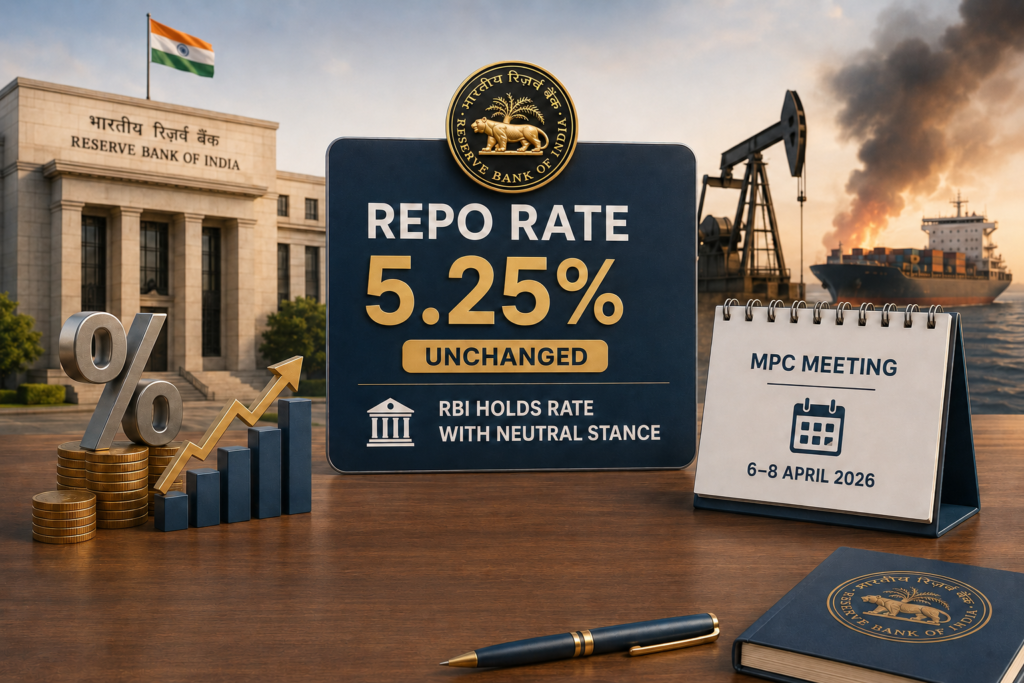
RBI Holds Repo Rate at 5.25% Again — Cites Iran War, Supply-Side Inflation Risks

Source: RBI Monetary Policy Statement (60th MPC Meeting, 6–8 April); Business Today; SCC Online; India.com; BankersAdda; APAC News Network In its first policy review of FY 2026-27, the RBI unanimously held the repo rate at 5.25% with a neutral stance. Governor Sanjay Malhotra cited the Iran conflict as creating heightened global uncertainties including disruptions in energy markets, rising commodity prices, and currency depreciation pressures. While headline inflation remains below target, the RBI flagged upside risks. The RBI explicitly noted that the shock is primarily supply-driven, making monetary policy a “blunt and potentially ineffective tool” to address it — an unusually candid statement. Rate hikes would only be considered if “second-round inflation effects” materialise. Growth projections: Q1 FY27 at 6.9%, Q2 at 7.0%. The RBI warned that the fiscal deficit may widen due to higher subsidy requirements for fuel and fertiliser. Next MPC meeting: 3–5 June 2026.

INCOME TAX, REGULATORY, SEBI

New Income Tax Act 2025 and SEBI Mutual Fund Regulations 2026 Take Effect

Source: ClearTax; Upstox News; Multiple AMC Notices (Quant, JM Financial, ICICI Prudential, ABSL, Baroda BNP, PGIM) Two major regulatory changes took effect simultaneously on 1 April 2026. The new Income Tax Act 2025 replaced the 60+ year old 1961 Act, with simplified provisions and streamlined compliance. Separately, SEBI’s Mutual Fund Regulations 2026 became effective, introducing the BER-based expense structure. Multiple AMCs issued notices revising their expense structures. Fund categories have been reclassified and scheme documents updated.

Book an Appointment Form