Author name: sreegesh@insightdrive.xyz

Part A - ETK

Death Without a Will — Navigating Succession

Death Without a Will — Navigating Succession Immediate Actions (First 30 Minutes) Short-term Steps (First 48 Hours to 2 Weeks) Resolution Steps (Next 1–3 Months) Steps to Take Now (While Everyone Is Alive and Well) Immediate Actions — First 30 Minutes 1 Obtain multiple certified copies of the death certificate — you will need them for every institution and legal process. 2 Identify and list all assets of the deceased: bank accounts, property, investments, shares, EPF, PPF, insurance policies, vehicles, and jewellery. 3 Identify all legal heirs: under Hindu law (for Hindus, Buddhists, Sikhs, Jains), Class I heirs are the spouse, children, and mother — they inherit equally. Under the Indian Succession Act (for Christians, Parsis, and those with no applicable personal law), the rules differ. 4 Do not take any hasty decisions about selling property or distributing assets without consulting all legal heirs — unilateral action creates disputes and can be legally challenged. 5 Secure all valuables, documents, and digital assets (email, banking apps, social media) to prevent misuse or unauthorised access. Short-Term Steps — First 48 Hours to 2 Weeks 1 Obtain a Legal Heir Certificate from the Tehsildar or revenue authority (for immovable property and some financial assets in many states) — this is faster than a Succession Certificate and sufficient for many purposes. 2 For financial assets with nominations (bank accounts, insurance, EPF, mutual funds): the nominee can claim directly using the death certificate and their identity — no court order needed. 3 For assets without nominations and above a certain threshold: apply for a Succession Certificate from the civil court. This is required for movable assets (shares, debentures, FDs) and gives the holder legal authority to collect and distribute. 4 File the final income tax return of the deceased for the financial year of death — this is the surviving family’s legal obligation. Any tax refund due belongs to the estate. 5 Inform all financial institutions (banks, AMCs, depositories) of the death and initiate the asset transfer process for each. Resolution Steps — Next 1–3 Months 1 Succession Certificate proceedings in civil court: file a petition in the district court of the deceased’s last place of residence. The court issues a notice, and if there are no objections within 45 days, grants the certificate. Total time: 3–6 months typically. 2 For property: obtain a Probate of Will (not applicable here — there is no will) or proceed through a family settlement deed (if all heirs agree) or a court partition suit (if they do not). 3 A family settlement deed (preferably registered with the sub-registrar office concerned) is the fastest and cheapest route when all heirs agree — it is a registered document that divides assets by mutual agreement and is legally binding. 4 For shares and demat accounts: SEBI has a simplified transmission process — the heir submits the death certificate, their identity proof, and an affidavit. No succession certificate is needed for amounts below ₹5 lakh. 5 Update property records and utility billing records (mutation) at the local municipal body, revenue department, Electricity department, etc., in each heir’s name after the succession process is complete. Steps to Take Now — While Everyone Is Alive and Well ✓ Write a will. It takes one day, costs ₹2,000–₹10,000 with a lawyer, and saves your family months of legal proceedings and potential conflict. ✓ Register the will at the Sub-Registrar’s office — a registered will is harder to challenge and easier to probate. ✓ Ensure all financial accounts have updated nominations — this bypasses the succession process for the most important financial assets. ✓ Have an explicit conversation with your family about your asset distribution wishes — even without a formal will, a family understanding reduces disputes. ✓ Review and update your will every 3–5 years or after major life events: marriage, birth of a child, acquisition of property, or divorce. Watch Video Guide Your browser does not support the video tag. Your Rights Under the Hindu Succession Act 1956 (as amended in 2005), daughters have equal inheritance rights to sons in ancestral property — this is a landmark change that many families are still unaware of. A widow has full rights to her husband’s self-acquired property. No heir can be disinherited without a will. Under the Indian Succession Act, the spouse’s share is one-third and the remainder goes to children. Key Contacts & Portals Who / What Contact / Action District Civil Court For Succession Certificate — file petition at deceased’s last residence Tehsildar / Revenue Office For Legal Heir Certificate — faster than Succession Certificate Sub-Registrar For family settlement deed registration SEBI Investor Portal scores.sebi.gov.in — for share transmission disputes Who / What Contact / Action EPFO unifiedportal-mem.epfindia.gov.in | 1800 118 005 Legal Aid nalsa.gov.in | 15100 Income Tax (filing final return) incometax.gov.in | 1800 103 0025
Part A - ETK

Home Burglary / Theft

Home Burglary / Theft Immediate Actions (First 30 Minutes) Short-term Steps (First 48 Hours) Resolution Steps (Next 2–4 Weeks) Prevention (For the Future) Immediate Actions — First 30 Minutes 1 Do not touch anything in the burgled area before the police arrive — disturbing the scene can compromise the police investigation and the insurance survey. 2 Call the police (100) immediately and file an FIR. The FIR is a non-negotiable requirement for a burglary insurance claim — without it, the claim cannot proceed. 3 Photograph the scene: the point of entry (broken window, damaged lock, forced door), the disturbed areas, and any visible damage. 4 Notify your home insurer immediately after filing the FIR — report the claim and provide the FIR number. Time-sensitive notification is required under most policies. 5 Make a preliminary list of all stolen items with estimated values, purchase dates, and any available purchase receipts or photographs. Short-Term Steps — First 48 Hours 1 Compile a detailed inventory of stolen items: photographs from previous occasions (social media, WhatsApp, cloud storage), purchase receipts, valuation certificates for jewellery, warranty cards for electronics. This evidence directly determines your claim amount. 2 Get the damaged entry points repaired — burst locks, broken windows — and keep the repair receipts. These are claimable as part of the burglary claim. 3 Submit the insurance claim with: FIR copy, list of stolen items with values, photographs of damage, and any available purchase evidence. 4 For jewellery claims: most home insurance policies have a specific sub-limit for jewellery (often 10–25% of the contents sum insured or a fixed amount). A valuation certificate from a certified jeweller strengthens the claim. 5 Inform your bank of any stolen documents (passbook, cheque book) or cards and get them replaced. Resolution Steps — Next 2–4 Weeks 1 The insurer will send a surveyor and may also verify with the police. Cooperate fully and provide all requested information promptly. 2 The claim settlement for stolen items is typically at the current market value (not replacement cost) minus depreciation, unless you have a ‘new for old’ or ‘reinstatement value’ policy. 3 If the insurer disputes the list of stolen items (common for cash claims — insurers are sceptical of large cash amounts): the burden is on you to establish what was kept at home. Bank withdrawal records showing large cash withdrawals before the burglary can help. 4 Cash claims under home insurance are typically limited to a small sub-limit (₹5,000–₹50,000 depending on the policy) — large cash holdings at home are generally not covered above this limit. 5 Track the police investigation — if they recover any stolen property, it may need to be returned to the insurer (if already settled) or taken back by you (if not yet settled). Prevention — How to Avoid This in Future ✓ Install good quality locks on all doors and windows — minimum ISI-marked 5-lever locks. Deadbolts add a further layer. ✓ Install CCTV cameras covering entry points — this deters burglars and provides evidence if they do enter. ✓ Keep a detailed photographic inventory of valuables (jewellery, electronics) stored in the cloud — dated photos and purchase receipts are invaluable at claim time. ✓ Do not keep large amounts of cash at home — use a bank account. Home insurance sub-limits for cash are low. ✓ Store jewellery in a bank locker for extended absences. Inform your insurer if you have a bank locker — some policies allow jewellery to be covered at the locker location too. Watch Video Guide Your browser does not support the video tag. Your Rights Burglary is a standard covered peril under comprehensive home insurance. The insurer cannot reduce your claim without documented grounds. For jewellery, they cannot apply depreciation if you have a current valuation certificate. The police FIR is both an investigative tool and your legal protection — do not delay filing it. Key Contacts & Portals Who / What Contact / Action Police FIR 100 — file immediately, do not disturb scene first IRDAI Bima Bharosa bimabharosa.irdai.gov.in | 155255 Insurance Ombudsman irdai.gov.in/web/guest/find-ombudsman Who / What Contact / Action Cyber Crime (for digital theft) cybercrime.gov.in | 1930 — if electronic devices used for fraud Local locksmith / security For emergency lock replacement — keep receipt

Part A - ETK

Health insurance claim rejected

Health Insurance Claim Rejected Immediate Actions (First 30 Minutes) Short-term Steps (First 48 Hours) Resolution Steps (Next 2–4 Weeks) Prevention (For the Future) Immediate Actions — First 30 Minutes 1 Read the rejection letter carefully and note the exact stated reason — ‘non-disclosure,’ ‘exclusion,’ ‘waiting period,’ ‘pre-existing condition,’ ‘policy lapsed,’ ‘procedure not covered,’ etc. The reason determines your next step. 2 Do not accept the rejection as final on the day you receive it — you have multiple levels of appeal. 3 Pull out your policy document and read the relevant clause that the insurer is citing. Many rejections cite clauses incorrectly or apply them too broadly. 4 Gather all documents: original hospitalisation records, bills, claim form, and any previous correspondence with the insurer. Short-Term Steps — First 48 Hours 1 Respond to the insurer’s rejection letter in writing within 15 days, specifically addressing their stated reason. Attach supporting documents that counter their grounds. 2 Common grounds you can challenge: (a) Pre-existing condition not disclosed: if the policy has been renewed for 5 continuous years (60 continuous months), the moratorium period protects you. (b) Waiting period: check if the exact condition was truly subject to a waiting period under your policy. (c) Experimental treatment: get a medical opinion confirming the treatment is standard, not experimental. (d) Non-network hospital: confirm whether pre-auth was sought within the required timeframe during an emergency. 3 Escalate to the insurer’s internal grievance officer (contact details must be in the policy document and on the insurer’s website). Request a review by a senior officer. 4 Keep a written record of all communications — dates, persons spoken to, and what was said. Resolution Steps — Next 2–4 Weeks 1 If the insurer’s internal grievance process does not resolve the matter within 30 days: file a complaint with the Insurance Ombudsman — this is free, fast (typically 3 months), and binding on the insurer for amounts up to ₹50 lakh. 2 The Insurance Ombudsman frequently rules in favour of claimants on pre-existing condition disputes, especially where the insurer cannot prove the customer knowingly concealed information. 3 If the Ombudsman ruling is also unsatisfactory: approach the Consumer Disputes Redressal Commission (consumer forum) or civil court. 4 For unjust or arbitrary rejections: IRDAI’s Bima Bharosa portal (bimabharosa.irdai.gov.in) accepts direct complaints against insurers. Prevention — How to Avoid This in Future ✓ Disclose all pre-existing conditions truthfully at the time of policy purchase — non-disclosure is the single biggest cause of claim rejection. New health insurance policies carry a 30-day free-look period, during which the policyholder may cancel the policy and obtain a refund after deduction of applicable charges. The 30-day clock begins from the date of receipt of the physical or electronic policy document, not from the purchase or commencement date. ✓ Read the exclusions section of your policy carefully before buying — not after a claim is filed. ✓ Renew your policy without a break every year — continuous coverage builds moratorium protection. ✓ Keep copies of all claim documents submitted — you need them if the claim is disputed. ✓ Buy from reputed insurers with a high claim settlement ratio (published by IRDAI annually). Watch Video Guide Your browser does not support the video tag. Your Rights IRDAI regulations require insurers to provide specific written reasons for claim rejection. Insurers cannot reject claims citing conditions that were not clearly excluded in the policy. After 5 continuous policy years (moratorium), no claim can be rejected on the grounds of non-disclosure or misrepresentation of pre-existing conditions (unless a fraud can be proven). The Insurance Ombudsman can award claims up to ₹30 lakh at no cost to the claimant. Key Contacts & Portals Who / What Contact / Action IRDAI Bima Bharosa bimabharosa.irdai.gov.in | 155255 Insurance Ombudsman (Nearest) irdai.gov.in/web/guest/find-ombudsman Consumer Forum (Online) edaakhil.nic.in Who / What Contact / Action IRDAI Grievance Call Centre 155255 or 1800 4254 732 (toll-free) Your insurer’s grievance officer Details in policy document — compulsory disclosure

Part A - ETK

Vehicle stolen

Vehicle Stolen Immediate Actions (First 30 Minutes) Short-term Steps (First 48 Hours) Resolution Steps (Next 2–4 Weeks) Prevention (For the Future) Immediate Actions — First 30 Minutes 1 Check that the vehicle has not been towed by the police or municipal authority — call the local traffic police helpline to verify before filing a theft report. 2 If confirmed stolen: file an FIR at the nearest police station immediately. Theft claims cannot proceed without an FIR — this is non-negotiable. 3 Notify your motor insurer’s helpline immediately after filing the FIR. Give them the FIR number, vehicle registration number, and circumstances of the theft. 4 Do not wait to see if the vehicle turns up before filing — any delay in both the FIR and insurer notification weakens your claim. 5 Inform your Regional Transport Office (RTO) about the theft — this is required for de-registration and claim processing. Short-Term Steps — First 48 Hours 1 Submit a non-traceable certificate from the police — this is issued after 90 days if the police investigation does not recover the vehicle. Some insurers require this before settling the theft claim. 2 Submit to your insurer: FIR copy, original RC book, both sets of keys (yes, both — insurers check for both keys as evidence you did not leave a key in the vehicle), original loan documents if the vehicle was financed, and the policy document. 3 If the vehicle had an active loan: notify the lender (bank or NBFC) immediately. The insurance payout in a theft claim is made partly to the lender (up to the outstanding loan amount) and the balance to you. 4 Block the vehicle’s FASTag — notify NHAI or your FASTag issuing bank to prevent misuse. 5 Check if you have a GPS tracker installed — provide the tracking data to the police as evidence. Resolution Steps — Next 2–4 Weeks 1 Theft claims are settled at the Insured Declared Value (IDV) minus the policy deductible. If your IDV was undervalued at the time of policy purchase, you will receive less than the market value — this is a common source of disappointment. 2 The insurer may request a ‘spot investigation’ to verify the circumstances of the theft — cooperate fully. 3 Settlement is typically processed within 90 days of the FIR, once the non-traceable certificate is obtained from the police. 4 After claim settlement: obtain a ‘No Objection Certificate’ from the insurer to de-register the vehicle at the RTO. The insurer takes the salvage rights (in case the vehicle is found later). 5 If the insurer disputes the claim or delays settlement beyond 90 days without valid reason: escalate to the Insurance Ombudsman. Prevention — How to Avoid This in Future ✓ Always park in lit, secured areas — theft from dark or isolated parking areas is far more common. ✓ Install a GPS tracker and/or an immobiliser — many insurers offer premium discounts for these. ✓ Never leave both sets of keys in or near the vehicle. ✓ Ensure your IDV reflects the current market value of your vehicle — revisit this every year at renewal. ✓ Check if your insurer offers a ‘Return to Invoice’ add-on — for new vehicles, this pays the original invoice price rather than the depreciated IDV. Watch Video Guide Your browser does not support the video tag. Your Rights Theft is covered under comprehensive motor insurance (not third-party only). The insurer must settle at the full IDV (the insured value agreed in the policy) minus any deductible. The insurer cannot reduce the payout citing depreciation for theft claims — depreciation applies only to repair claims, not total loss / theft. You are entitled to compensation for the stolen vehicle even if the police have not recovered it, once the non-traceable certificate is issued. Key Contacts & Portals Who / What Contact / Action Police FIR 100 or nearest police station — file immediately NHAI FASTag Block fastag.nhai.org or your issuing bank Vahan Portal (RC) vahan.parivahan.gov.in — for RTO reporting Who / What Contact / Action Your motor insurer helpline Notify same day as FIR filing IRDAI Bima Bharosa bimabharosa.irdai.gov.in | 155255 General Insurance Council gicouncil.in | 1800 200 5505

Part A - ETK

Lost or stolen debit / credit card

Lost or Stolen Debit / Credit Card Immediate Actions (First 30 Minutes) Short-term Steps (First 48 Hours) Resolution Steps (Next 2–4 Weeks) Prevention (For the Future) Immediate Actions — First 30 Minutes 1 App/Internet Banking: Open your bank’s mobile app or log into your net banking account. Most apps have a toggle switch or a card management section to temporarily freeze or block the card. SMS:Many banks, allow you to block the card instantly via an SMS code sent from your registered mobile number. Call your bank’s 24×7 card helpline immediately and request a hot-listing (blocking) of the card. Do not wait to be ‘sure’ the card is stolen. 2 Note the date, time, and name of the customer care agent who blocks the card. 3 Check your recent transactions on your bank’s app or SMS alerts for any unauthorised debits. 4 If you see any fraudulent transactions, tell the agent immediately and ask to raise a fraud dispute simultaneously with the block. 5 Change your net banking and mobile banking password as a precaution. Short-Term Steps — First 48 Hours 1 Visit your nearest bank branch or apply online for a replacement card. Most banks issue a replacement within 5–7 working days. 2 If the card was stolen (not misplaced), file an FIR at the nearest police station — this is required for any insurance claim and for the bank’s fraud investigation. 3 Check your transaction history thoroughly. If you notice any unauthorized or suspicious purchases, report them to your bank immediately. Dispute any unauthorised transaction in writing (email or branch letter) citing the RBI guideline on zero liability for fraud not attributable to the customer. 4 Delink from the card all the debits (recurring payments) for utilities/other subscriptions etc. immediately Activate virtual cards or use UPI for transactions until the replacement card arrives. 5 Inform your employer if the card was linked to salary account auto-debits (loan EMIs, SIPs). Resolution Steps — Next 2–4 Weeks 1 Apply for the replacement card and follow up on the replacement card delivery — track via the bank’s app or courier tracking number. 2 Once the fraud dispute is filed, the bank must respond within 90 days (RBI mandate). Keep all written correspondence. 3 If the bank rejects your fraud claim unfairly, escalate to the RBI Banking Ombudsman within 30 days of rejection. 4 Update any standing instructions, auto-pay mandates, or subscription services linked to the old card number. 5 Check your CIBIL report after 30 days to ensure no fraudulent credit enquiries were made. Prevention — How to Avoid This in Future ✓ Register for transaction SMS and email alerts — know instantly if your card is used. ✓ Enable international transaction block by default; lift it only when travelling. ✓ Store your bank’s card helpline number in your phone before you ever need it. ✓ Never write your PIN on the card or store it in the same wallet. ✓ Use a virtual card number for all online purchases where possible. Watch Video Guide Your browser does not support the video tag. Your Rights Swift reporting helps limit your liability, as many banks have “zero liability” policies for timely reported fraudulent transactions. Under RBI circular on Customer Protection (2017), if you report the loss promptly and the fraud was not due to your negligence, your liability is ZERO for third-party fraud. Even if there is a delay in reporting, your maximum liability is capped (₹5,000–₹10,000 depending on account type). The bank cannot hold you liable for transactions after the card was reported lost. Key Contacts & Portals Who / What Contact / Action SBI Cards 1800 180 1290 (toll-free) HDFC Bank Cards 1800 202 6161 (toll-free) ICICI Bank Cards 1800 102 4242 (toll-free) Axis Bank Cards 1800 419 5959 (toll-free) Who / What Contact / Action Kotak Bank Cards 1860 266 2666 RBI Ombudsman crpc.rbi.org.in | 14448 National Cyber Crime cybercrime.gov.in | 1930 Card block via SMS Most banks: SMS BLOCK <last 4 digits> to bank’s SMS number

Insurance

Term Insurance Death Claim Process

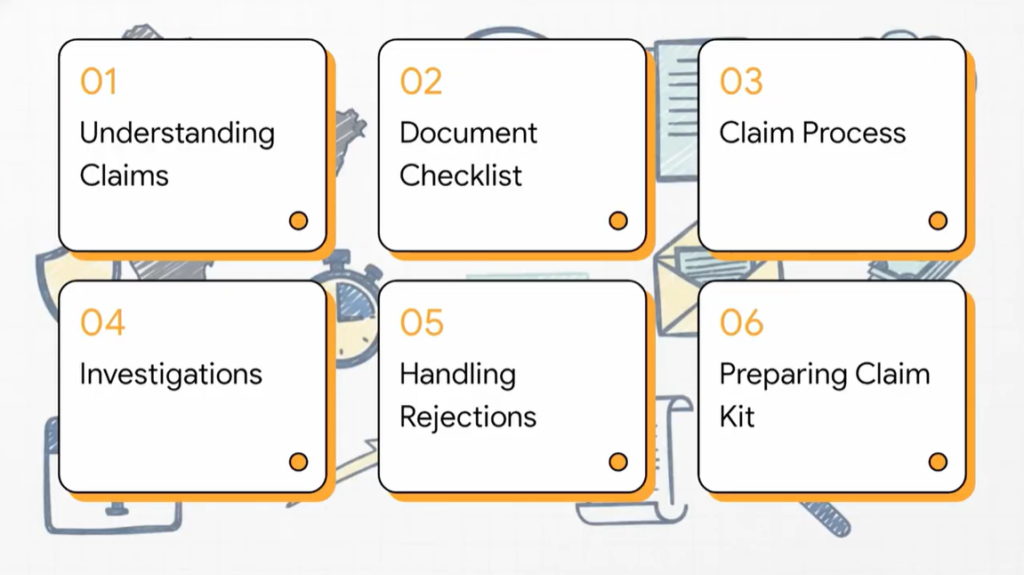
Term Insurance Death Claim Process This text serves as a practical guide for nominees on how to file a term life insurance death claim in India. It breaks the process down into manageable steps, starting with immediate intimation to the insurer within 48 hours, followed by the collection of crucial medical and legal documents. The guide explains typical settlement timelines, noting that most straightforward claims are processed within 30 to 60 days, though early deaths may trigger investigations. Ultimately, it strongly advises policyholders to prepare a “claim kit” in advance to minimize stress and procedural delays for their families.

Insurance

How to Claim Motor Insurance

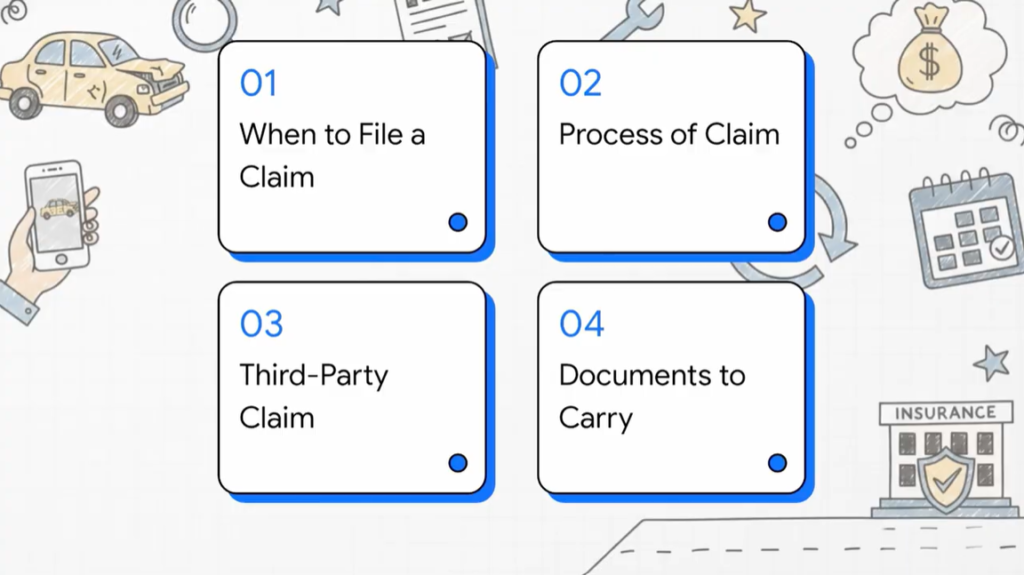
How to Claim Motor Insurance This document outlines the standard procedure for filing a motor insurance claim in the event of an accident, theft, or natural disaster. It emphasizes the importance of immediately informing the insurer, lodging an FIR for major incidents, and thoroughly documenting the vehicle’s damage. The guide explains the differences in handling accident claims versus third-party injury claims, strictly advising against settling out of court in the latter scenario. It also provides comprehensive checklists of the essential documents required for each specific type of motor claim.

Insurance

Guide to the Insurance Ombudsman

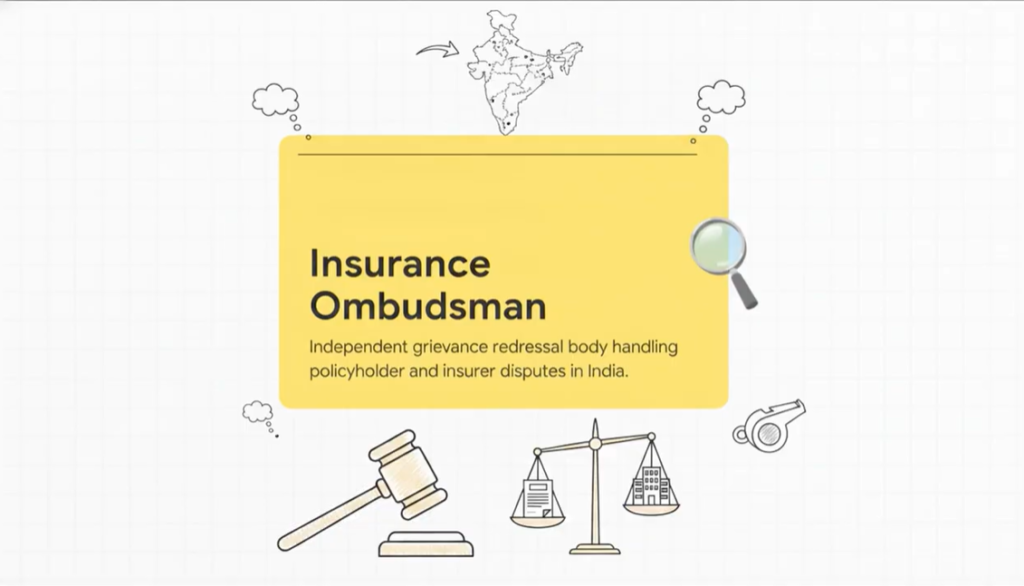
Guide to the Insurance Ombudsman This step-by-step guide explains how to utilize the Insurance Ombudsman, an independent and free grievance redressal body for disputes up to ₹50 lakhs. It outlines the strict eligibility criteria, notably the requirement to first exhaust the insurer’s internal grievance process before filing. The text details the mandatory documents needed, how to draft a chronological statement of facts, and the available online and offline submission methods. Finally, it clarifies the 90-day resolution timeline and notes that Ombudsman orders are legally binding on insurers up to ₹30 lakhs.

Insurance

The Digital Health & Claims Lens (ABHA & NHCX)

The Digital Health & Claims Lens (ABHA & NHCX) This text introduces the Ayushman Bharat Digital Mission’s digital public infrastructure, specifically focusing on the ABHA and NHCX platforms. It explains how creating an Ayushman Bharat Health Account (ABHA) centralizes a patient’s medical records and drastically reduces hospital registration times. Concurrently, it details how the National Health Claims Exchange (NHCX) standardizes and accelerates the insurance claim process, replacing manual paperwork with a digital gateway. The guide urges policyholders to adopt these digital tools to ensure faster pre-authorizations, smoother hospital discharges, and a paperless experience.

Insurance

The Health Insurance Claims Process

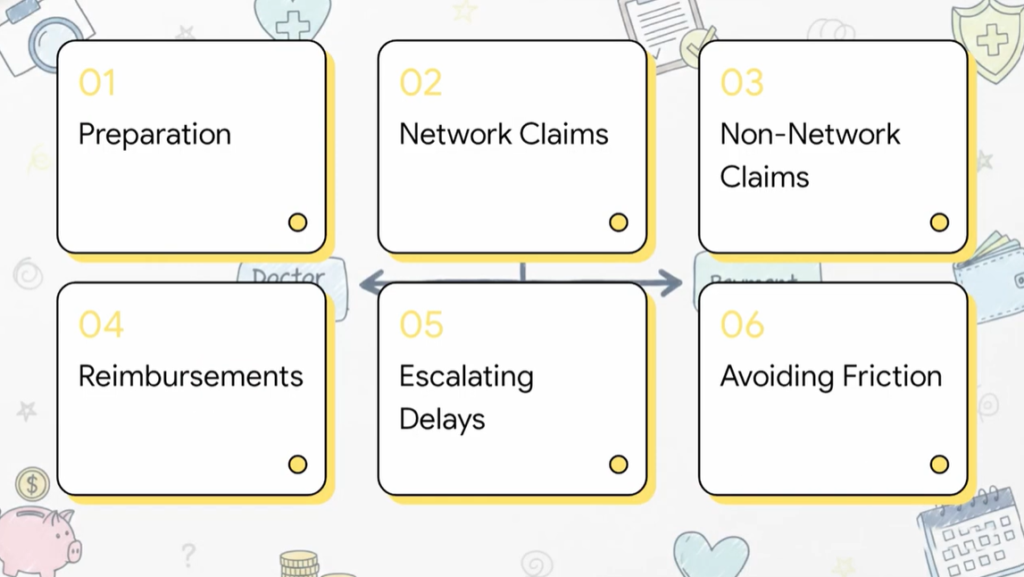
The Health Insurance Claims Process This document provides a comprehensive walkthrough of the health insurance claims workflow for both cashless and reimbursement scenarios. It details the required steps for planned and emergency admissions, noting strict IRDAI timelines such as one-hour pre-authorization responses for planned procedures. Furthermore, it outlines the specific documents needed for filing a reimbursement claim within the typical 30-day post-discharge window. The guide also includes a clear escalation path to follow if an insurance company delays the processing of a claim.

Book an Appointment Form