Bank Accounts

Bank Accounts

Cheques, Demand Drafts & Banker’s Cheques

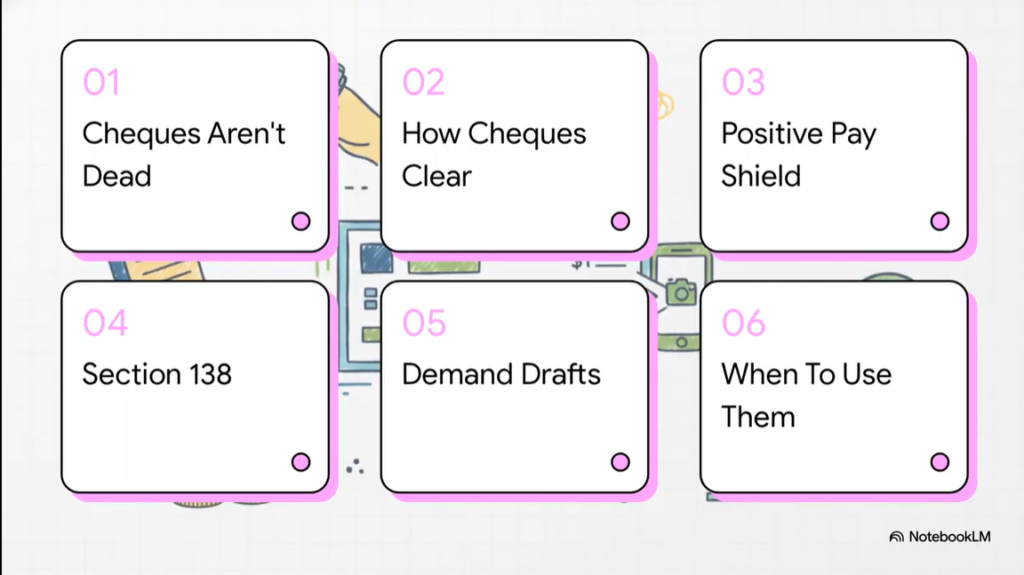
Cheques, Demand Drafts & Banker’s Cheques Cheques remain relevant for specific situations — institutional requirements, security deposits, and contexts where Section 138’s legal weight matters — even as digital rails handle most transaction volume. This guide covers the Cheque Truncation System (CTS), under which cheques are scanned and cleared via image rather than physical movement, typically within about a day; the CTS-2010 security standard; and the cheque validity period of 3 months (reduced from 6 months by an RBI circular effective April 2012) — a “stale” cheque is returned regardless of available funds. We cover the Positive Pay System (mandatory for cheques of ₹5 lakh and above under RBI’s January 2021 directive, though many banks apply it at lower thresholds set by their own policy), cheque dishonour and Section 138 of the Negotiable Instruments Act (a criminal offence for insufficient-funds dishonour of a cheque issued against a genuine debt, with a mandatory notice period before prosecution), and stop payment instructions. Finally, we clarify the genuine differences — and convergence — between Demand Drafts, Banker’s Cheques, and Pay Orders, all pre-funded bank-issued instruments that cannot bounce for insufficient funds, and when they still make sense versus electronic alternatives.
Bank Accounts

Receiving Money From Abroad: Things to Do

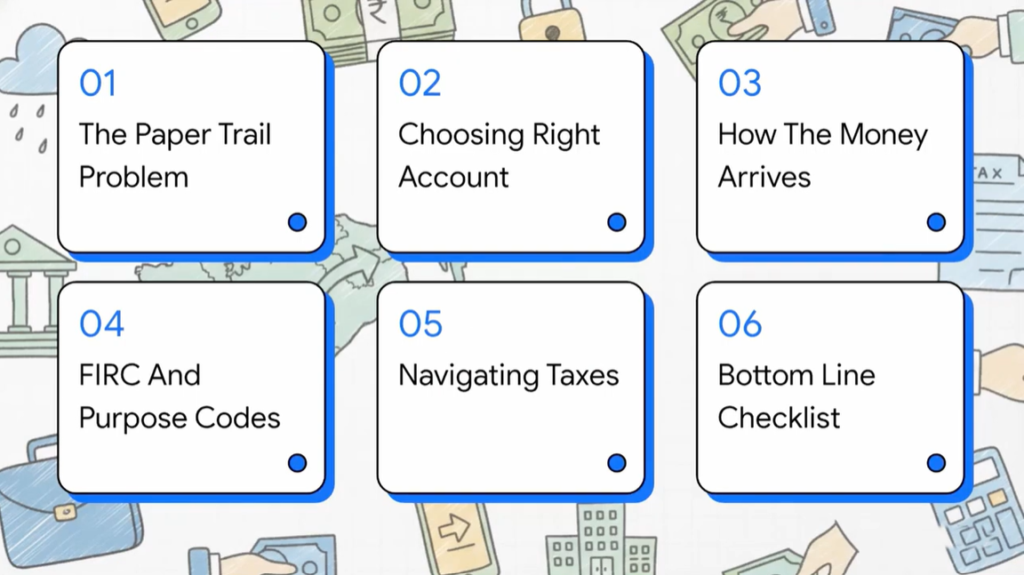
Receiving Money From Abroad: Things to Do Receiving money from abroad starts with the right account — NRE (fully repatriable, tax-exempt interest) or NRO (for India-sourced income or funds with repatriation conditions) for NRIs, a standard account for residents, with rupee gifts to NRI relatives routed to NRO accounts. This guide covers the main inward channels (SWIFT, online remittance platforms, the Money Transfer Service Scheme for personal remittances, and Rupee Drawing Arrangements common for NRI family transfers), and the Foreign Inward Remittance Certificate/Advice (FIRC/FIRA) — essential evidence for exporters of services claiming GST zero-rating via LUT, and useful source-of-funds proof generally, best requested at the time of receipt rather than later. We cover purpose codes on the receiving side and why consistency with the payment’s actual nature matters, and — the section that determines everything downstream — the four distinct tax treatments: gifts from relatives (exempt under Section 56(2)(x)), gifts from non-relatives (taxable above ₹50,000/year cumulatively), export proceeds (business income, with FEMA realisation-period obligations separate from tax filing), and proceeds from sale of foreign assets (potential capital gains, with the remittance being separate from the underlying tax event).

Bank Accounts

Transferring Money Abroad

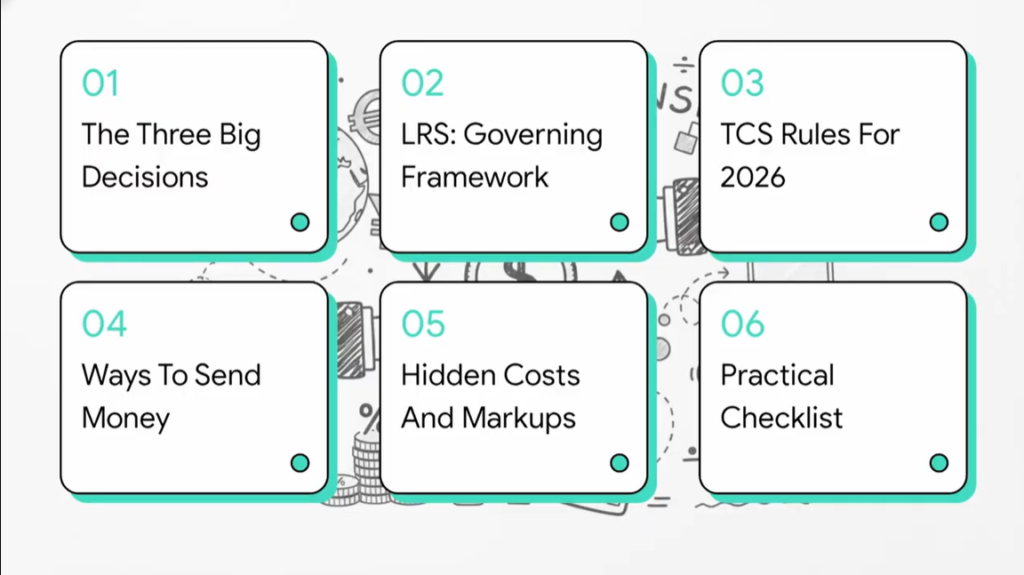
Transferring Money Abroad: Ways of Sending & Things to Know Outward remittances from India operate under the Liberalised Remittance Scheme (LRS) — up to USD 250,000 per resident individual per financial year, across all banks combined. This guide covers the Tax Collected at Source (TCS) framework as of mid-2026: a ₹10 lakh annual threshold (per PAN, across all LRS remittances) below which no TCS applies, and — following Finance Act 2026 changes effective 1 April 2026 — a reduced 2% TCS rate (down from 5%) on medical/education/travel remittances above this threshold, and 2% with no threshold at all for overseas tour packages (down from a 5%/20% structure); education funded via a qualifying education loan remains NIL-TCS. We flag that “other” LRS purposes like investments and gifts may continue to attract 20% TCS above ₹10 lakh — worth confirming, as the April 2026 reductions appear targeted at medical/education/travel specifically. We cover the sending channels (SWIFT wire transfer, online remittance platforms, forex cards, foreign-currency demand drafts), Form A2 and purpose codes, the often-overlooked exchange rate markup as a hidden cost, and intermediary/correspondent bank charges (OUR vs SHA) that can reduce the amount a recipient actually receives on SWIFT transfers.

Bank Accounts

UPI, UPI Lite, UPI AutoPay & Digital Wallets

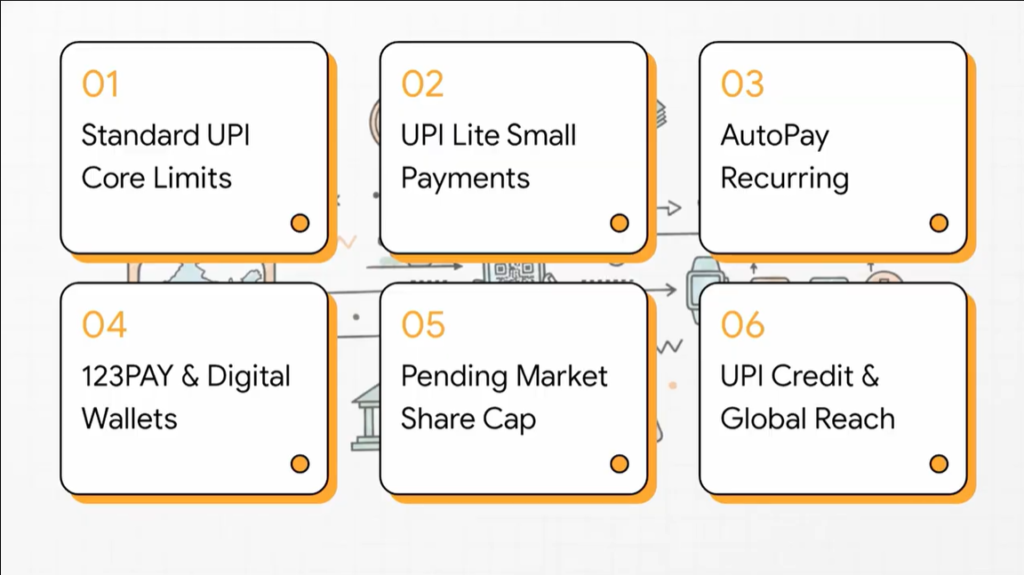
UPI, UPI Lite, UPI AutoPay & Digital Wallets UPI’s standard limit is ₹1 lakh per transaction and per day (on a rolling 24-hour basis, not a midnight reset), with enhanced limits up to ₹2–5 lakh — and in specific cases up to ₹10 lakh — for verified categories like insurance, capital markets, and government payments. This guide covers UPI Lite (an on-device wallet, raised to a ₹5,000 balance limit in October 2024, for small payments tracked separately from your main UPI limit, plus UPI Lite X for offline NFC payments), UPI AutoPay (recurring mandates up to ₹15,000 without extra authentication, and up to ₹1,00,000 for specific categories like insurance and credit card bills per a December 2023 NPCI circular), and UPI 123PAY (feature-phone access, capped at ₹10,000 per transaction). We cover digital wallets/PPIs and their KYC-tiered limits and interoperability mandate, UPI’s international expansion to countries including Singapore, UAE, and Nepal, and RuPay-credit-card/credit-line-on-UPI products. We close with the NPCI’s proposed 30% market-share cap on dominant apps like PhonePe and Google Pay — a measure repeatedly delayed and, as of mid-2026, still not enforced.

Bank Accounts

Online Loans: Safety vs. Convenience

Online Loans: Safety vs. Convenience India’s digital lending ecosystem includes genuinely legitimate, RBI-regulated online lenders (banks and NBFCs, or fintech Lending Service Providers partnering with them) and a persistent class of illegal, unregistered lending apps that use coercive recovery, data weaponisation, and predatory rates. Under RBI’s Digital Lending Directions (issued 8 May 2025), all Digital Lending Apps must be registered with CIMS by June 2025 and listed on their regulated entity’s official website — creating a verifiable whitelist. Legitimate digital loans must: provide a Key Facts Statement (with APR disclosed, not just flat rates) before borrower acceptance; offer a minimum one-day cooling-off period for penalty-free exit; disburse directly to the borrower’s bank account; restrict app data permissions to KYC-only (no contact list/call log access); and store all data in India. Red flags for predatory/illegal apps: no named RBI-regulated lender, excessive device permissions, disbursement to a wallet, instant approval with zero KYC, and interest expressed as daily/weekly rates without APR. We cover the practical risks of legitimate digital lending too: impulsive borrowing due to speed, multiple simultaneous loans increasing aggregate debt burden, and the debt-management problem at portfolio level that individual-loan convenience can create. For victims of illegal lending: cybercrime.gov.in for harassment, sachet.rbi.org.in for illegal lending activity, and state police under the IT Act/BNS for data misuse.

Bank Accounts

 BNPL — A Debt Trap or Convenience?

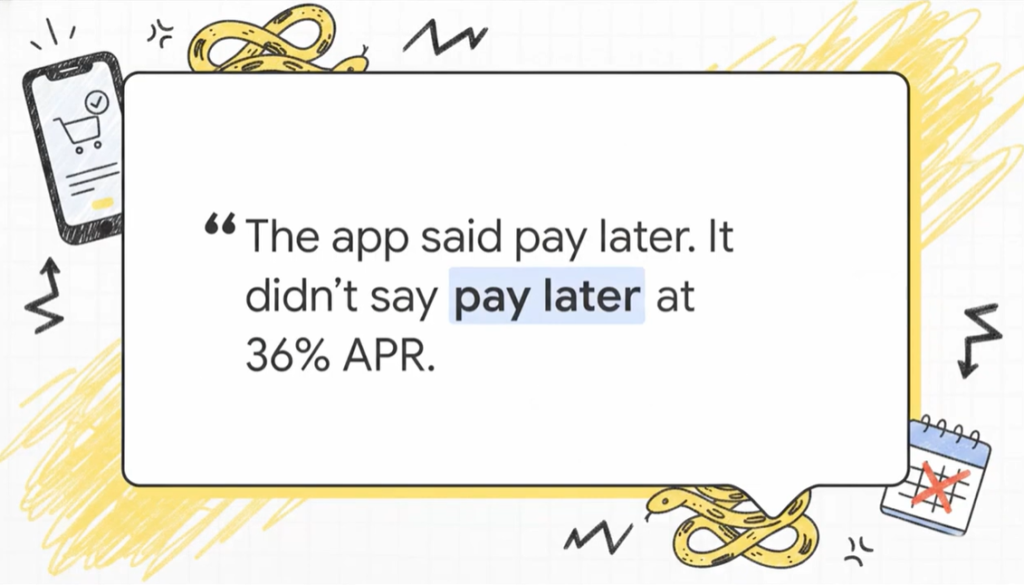
 BNPL — A Debt Trap or Convenience? BNPL (Buy Now Pay Later) extends short-term credit at the point of purchase — either as a deferred single payment (typically 14–30 days) or in short-tenure instalments. This guide explains the actual cost structure: ‘zero interest’ applies only within the free period, and beyond it, flat monthly rates (commonly 2–3%) translate to APRs well above 24–36% when annualised, with processing fees adding further to the all-in cost. Under RBI’s May 2025 Digital Lending Directions (superseding 2022 guidelines), all regulated BNPL providers must: disclose APR (not just flat rates) in a mandatory Key Facts Statement before acceptance; offer a minimum one-day cooling-off period for exit without penalty (except disclosed processing fees); disburse funds directly to the borrower’s bank account; restrict app data permissions to KYC-only (no contacts/call log access); and store all data in India. We cover the 2022 PPI credit-loading ban that reshaped BNPL models, the 5% FLDG cap that transferred underwriting risk back to regulated lenders, and mandatory credit bureau reporting of all BNPL transactions (making missed BNPL repayments identical to missed EMIs from a credit score perspective). Debt trap dynamics covered: spending beyond means across multiple platforms, rollover-to-EMI conversion at higher rates, and loss of visibility over aggregate obligations. Legitimate use case: single planned purchase, repaid within zero-interest window from expected funds.

Bank Accounts

Loan Account Monitoring

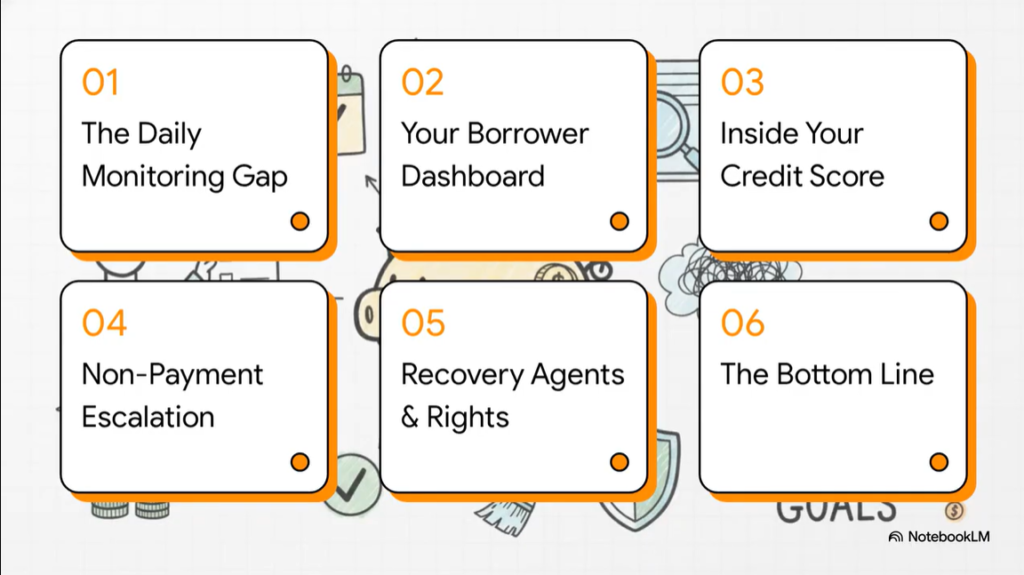
Loan Account Monitoring: Staying in Control of Your Debt Monitoring a loan account goes beyond confirming that the EMI has been deducted. This guide covers what to track: outstanding principal (not just the EMI amount), floating interest rate verification against the lender’s published EBLR after every reset, penal charges (which post April 2024 must be defined events, not compounding interest — any label of ‘penal interest’ on a post-April 2024 loan is a compliance breach), and the annual loan account statement. We explain how loan accounts affect the credit score: payment history (including DPD — Days Past Due — reported monthly to all four credit bureaus) carries the highest weight, a single missed EMI can drop the score by 50–100 points, and the record stays for up to 7 years. We map the progressive escalation of non-payment: SMA-0 (1–30 days overdue), SMA-1 (31–60 days), SMA-2 (61–90 days), NPA classification at 90 days (triggering SARFAESI for secured loans and DRT recovery for amounts above ₹20 lakh), and the RBI’s Fair Practices Code governing recovery agent conduct (prior notification mandatory, no contact outside 8 AM–7 PM, no harassment). Practical monitoring habits: quarterly outstanding principal check, annual credit report review (free from all four bureaus, no hard inquiry for self-checks), and maintaining a minimum one-month EMI buffer in the debit account.

Bank Accounts

Credit Cards

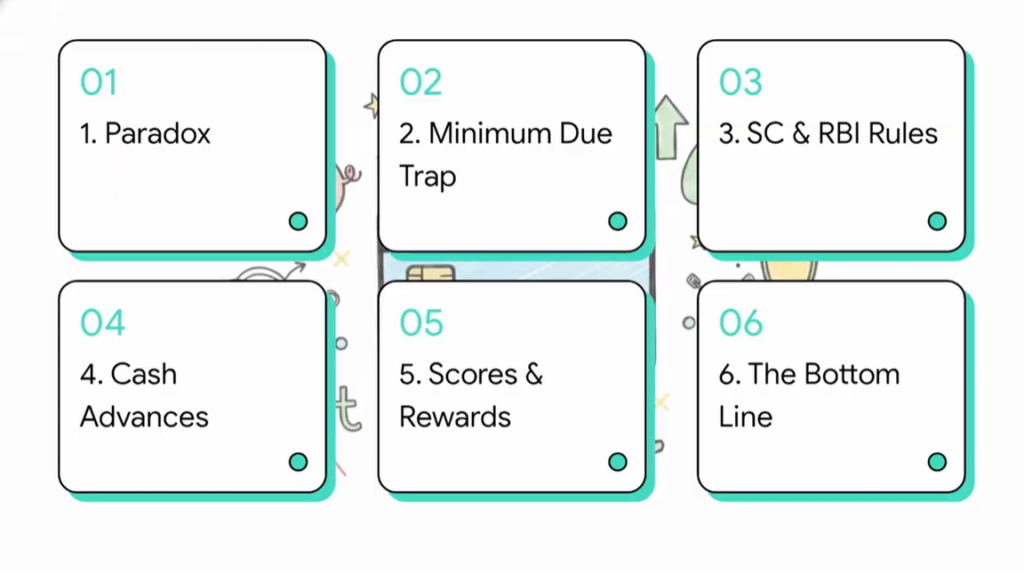
Credit Cards A credit card is revolving credit — interest-free if the full statement balance is paid by the due date (typically 20–50 days from purchase), but with that interest-free period lost entirely on all transactions, including new ones, the moment any balance is carried forward, even via paying only the Minimum Amount Due. This guide explains the MAD trap in detail, and covers the December 2024 Supreme Court ruling that removed an earlier ~30% cap on credit card interest rates — meaning issuer-disclosed rates (often up to the high-30s/around 49% annualised) now apply without an external ceiling, making the MITC disclosure essential reading. We cover the RBI Master Direction framework: late payment charges only after a 3-day grace period and calculated only on the post-due-date outstanding (from October 2024), a 7-working-day card closure deadline backed by a ₹500/day penalty, bans on unsolicited issuance/upgrades, and card network portability for large issuers. We also cover cash advances (no interest-free period, plus a separate fee — the most expensive credit in this series), forex markup and TCS on international spending, EMI conversion’s often-understated true cost, and how credit utilisation affects your score and, in turn, the personal loan rates covered in Topic 29.

Bank Accounts

Personal Loans

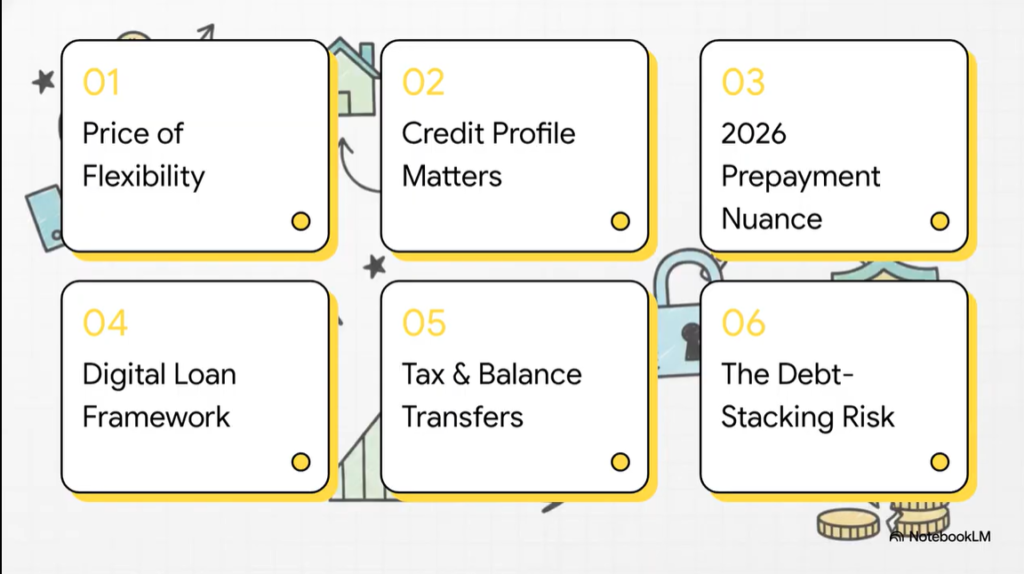
Personal Loans A personal loan is unsecured — no collateral, generally no end-use restriction — making it the most flexible and most expensive loan category covered in this series, with pricing driven almost entirely by the borrower’s credit profile (CIBIL/bureau score, FOIR, employment stability) and lender category (banks vs NBFCs vs digital lenders). This guide explains why most personal loans, being fixed-rate, fall outside the 2026 RBI prepayment-charge reforms that benefit floating-rate LAP and home loans — making it essential to check prepayment terms explicitly. We cover the RBI’s digital lending framework in detail: direct disbursal to the borrower’s account (no pass-through via Lending Service Providers), the Key Fact Statement and APR disclosure, the cooling-off period allowing penalty-free exit shortly after disbursal, consent requirements for credit limit increases, and data-privacy restrictions on app access to phone data. We close with end-use-dependent tax treatment, balance transfer economics, and the debt-stacking risk that’s structurally easier with unsecured, minimally-documented personal loans than with any secured loan type in this series.

Bank Accounts

Education Loans

Education Loans Education loans are shaped by the IBA’s Model Education Loan Scheme (2022), with a tiered collateral structure: no collateral or guarantor up to ₹4 lakh, a guarantor (but no collateral) up to ₹7.5 lakh, and collateral required above that — though private lenders often extend collateral-free limits well beyond ₹7.5 lakh based on institution, course, and co-applicant profile. This guide covers what’s financed (tuition, accommodation, books/equipment, and study-abroad travel), interest rates (secured vs unsecured, benchmark-linked), and the moratorium period — where simple interest accrues during the course-plus-grace-period even though EMIs are paused, with a real choice between servicing this interest or letting it capitalise into the principal. We detail two distinct government interest-subsidy schemes (CSIS for economically weaker students in India, and the Dr. Ambedkar Central Sector Scheme for OBC/EBC students covering both India and study abroad), PSL classification, the Vidya Lakshmi common application portal, and Section 80E — the uncapped interest-only tax deduction available for 8 years from the start of repayment, for loans taken for the borrower, spouse, children, or legal wards.

Book an Appointment Form