

ECONOMY

ECONOMY

Cryptos and their Regulation in India

Cryptos and their Regulation in India The central authority has categorized cryptocurrency as a Virtual Digital Asset (VDA), systematically locking speculative tokens into a highly restrictive tax purgatory. By treating crypto transactions under a unique regulatory framework, the sovereign house has established an environment where traditional net-profit accounting rules completely disappear.  Before you trade highly volatile digital narratives expecting exponential portfolio expansion, you need to ask a much harder question: “Have I mathematically priced in the asymmetric tax friction designed to penalize my capital?” Navigating the heavily guarded crypto trading arena requires analysing three severe statutory barriers: Don’t chase a volatile speculative mirage while ignoring your long-term wealth foundations; trading high-frequency crypto instruments without exponential gains ensures the structural tax drag slowly drains your capital.  Watch this video to expose the asymmetric math of VDA regulations and learn how to benchmark speculative plays accurately against low-cost, tax-efficient equity index models.

ECONOMY

What The Digital Rupee Means For You

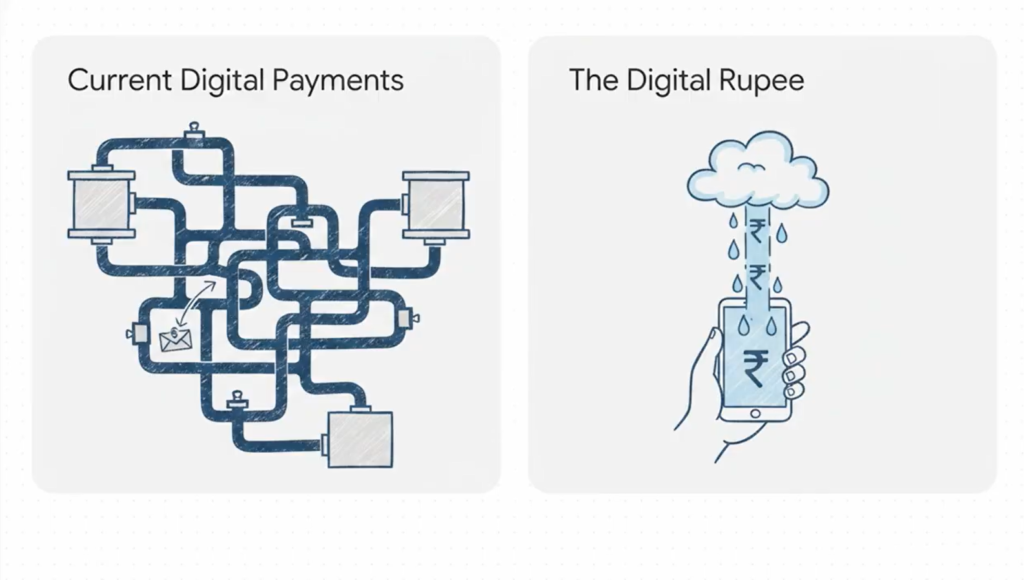
What The Digital Rupee Means For You The transformation of currency has reached its final frontier with the Central Bank Digital Currency (CBDC), converting standard money into pure digital cash backed by the sovereign credit of the state. Operating as an absolute liability of the RBI, the e-Rupee completely eliminates the commercial credit risk inherent in traditional bank deposits.  Before you confuse this sovereign token with standard smartphone applications, you need to ask a much harder question: “Do I understand the profound structural difference between the asset itself and the payment messenger?” Mastering the new digital legal tender requires tracking three high-utility structural shifts: Don’t allow excess transaction capital to accumulate idly inside your digital wallet; holding non-interest-bearing cash tokens long-term ensures your real-world purchasing power is quietly eroded by inflation.  Watch this video to unlock the full potential of programmable e-Rupees and discover how to safely balance your liquid cash tokens against your active growth assets. 

ECONOMY

AI in Financial Services: How Algorithms Decide Your Loan Approval

AI in Financial Services: How Algorithms Decide Your Loan Approval The traditional human drama of presenting your character to a bank manager for a loan has been permanently replaced by a ruthless digital mirror. Modern financial institutions deploy advanced machine learning algorithms to scan thousands of alternative data points in milliseconds, scoring your precise creditworthiness via automated data classification patterns.  Before you access credit or pay-later convenience tools across consumer apps, you need to ask a much harder question: “Is my unmonitored smartphone footprint flashing a severe risk signal to underwriting neural networks?” Optimizing your behavioural profile for automated underwriting models requires practicing strict digital hygiene across three data vectors: Don’t let erratic digital habits crack your financial mirror; unstructured spending signals tell the machine that your household lifestyle is completely untethered from stable earnings.  Watch this video to execute a thorough data hygiene audit on your linked bank accounts

ECONOMY

Data as Currency

Data as Currency Every swipe, tap, and digital scan you execute emits a high-resolution financial signal that institutional systems harvest, package, and utilize as a valuable shadow balance sheet. This data exhaust maps your granular behavioural heartbeat, transforming your financial reputation into a highly liquid digital currency that lenders track in real-time.  Before you routinely click “I Agree” to accelerate a digital interface, you need to ask a much harder question: “Am I trading away an invaluable long-term data asset just to capture a temporary nominal convenience?” Securing your digital vault from predatory institutional mining requires navigating three major data-sharing channels: Don’t allow unmonitored tracking permissions to clutter your risk score; unmanaged data exposure enables automated underwriting models to penalize your borrowing options.  Watch this video to build a robust digital moat around your wealth accounts and learn how to audit your active aggregator consents to preserve your financial privacy. 

ECONOMY

The Marriage Market Economy

The Marriage Market Economy India’s wedding industry has ballooned into a massive $139 billion behemoth, expanding at an aggressive annual velocity of 15% that aggressively outpaces general salary increments. In this high-stakes ecosystem, weddings function as ultra-competitive positional goods where families routinely engage in heavy theatrical consumption for social signalling.  Before you greenlight a massive production budget for a single celebratory evening, you need to ask a much harder question: “Am I trading away my long-term wealth tier growth to fund a temporary nominal memory?” Scripting a sustainable wedding budget without destroying your financial health requires tackling three distinct cost traps: Don’t let competitive social indexing pressure you into over-leveraging your private silo; starting a relationship under a severe interest drag deletes your immediate career optionality.  Watch this video to implement a disciplined wedding sinking fund using the future value calculation and learn exactly how to execute a strategic guest list audit to maximize your real financial margin. 

ECONOMY

Financial Implications of Nuclear Families

Financial Implications of Nuclear Families The structural fragmentation of the traditional Indian joint family into isolated nuclear units is fundamentally shifting the country’s risk and resource dynamics. Moving away from a shared economic caravan to operate as solo backpackers grants immense personal autonomy but permanently deletes the protective economies of scale that historically safeguarded household wealth.  Before you celebrate the lifestyle upgrades of a private household, you need to ask a much harder question: “Am I financially equipped to absorb the total loss of my family’s informal safety net?” Navigating a solo financial expedition securely requires managing three severe structural surcharges: Letting low EMIs lure you into high fixed liabilities destroys options, converting minor short-term cash flow crunches into catastrophic household crises.  Watch this video to calculate the real cost of household autonomy and discover how to deploy equity alpha to reliably self-fund your solo financial journey using the fundamental compounding formula:

ECONOMY

India’s Ageing Population

India’s Ageing Population While the mainstream economic discourse celebrates a young workforce, a silent demographic debt is accruing as India approaches an irreversible grey tsunami. With the old-age dependency ratio projected to double by 2050, traditional community safety nets are vanishing, leaving individuals entirely responsible for stocking their own retirement silos.  Before you assume your current long-term savings are sufficient to survive the winter, you need to ask a much harder question: “Am I relying on a fragile nominal fallback or a real compounding engine?” Stocking your private retirement silo before the growing season ends requires balancing two contrasting financial gears: Treating children as retirement assets or resting on stagnant family properties destroys options, transforming a thirty-year retirement winter into a catastrophic cash crunch.  Watch this video to calculate the true future cost of your lifestyle and discover how to deploy disciplined equity exposure to secure your financial independence. 

ECONOMY

Urbanisation and its Financial Implications

Urbanisation and its Financial Implications The massive demographic migration shifting India’s population toward urban hubs operates as a powerful economic magnet, completely rewriting how wealth is generated, stored, and spent. By 2030, an estimated 600 million people will reside in Indian cities, driving a rapid structural transition away from volatile, seasonal agricultural earnings toward high-velocity urban output.  Before you allocate your real estate capital into stagnant legacy markets, you need to ask a much harder question: “Am I tracking the infrastructure multipliers that dictate the real value of emerging cities?” Riding the tidal wave of national urban migration requires mapping out three critical economic transformations: Don’t let lifestyle inflation erode your urban earnings; your career alpha and asset selection must actively keep pace with the sheer velocity of population density.  Watch this video to decode the forward-looking map of Indian urbanization and learn exactly how to identify satellite property zones built for exponential growth.

ECONOMY

Demographic Dividend: Boon or Bane?

Demographic Dividend: Boon or Bane? With over 65% of its population positioned under the age of 35, India operates a massive economic solar array capable of fuelling unparalleled consumption growth. However, this demographic dividend is on a strict biological clock, and unless the workforce secures a rapid skills update, it risks converting into a heavy structural burden.  Before you let a booming national youth narrative dictate your long-term career comfort, you need to ask a much harder question: “Am I building the specialized skill charge required to survive a hyper-competitive job market?” Capitalizing on India’s generational shifting window requires evaluating three critical demographic forces: Relying on generic degrees or routine skills in an automated corporate environment destroys options, trapping your career path below the survival baseline of national growth.  Watch this video to capture direct equity alpha from India’s structural consumption engine and learn how to insulate your long-term wealth timeline before the dividend clock expires. 

ECONOMY

Economic Impact of Water Scarcity

Economic Impact of Water Scarcity Water can no longer be evaluated as a free environmental gift; it operates as a primary macroeconomic input whose depletion levies a severe, compounding dehydration tax across the financial system. As urban groundwater levels collapse, a stark divergence is emerging between water-secure locations and real estate properties that function as dry assets.  Before you execute a property transaction based entirely on premium location branding, you need to ask a much harder question: “Am I buying into a real estate corridor that is running a high risk of systemic dehydration?” Protecting your capital from the silent erosion of water scarcity requires tracking three systemic risk pipelines: Ignoring localized environmental security ratings destroys your options, transforming an apparently safe physical asset into a highly illiquid, expensive liability.  Watch this video to check your city’s structural groundwater risk maps and learn how to identify high-alpha resilience stocks in water treatment ecosystems. 

Book an Appointment Form