
Income Tax Demand Notice Received
Immediate Actions — First 24–72 Hours
1
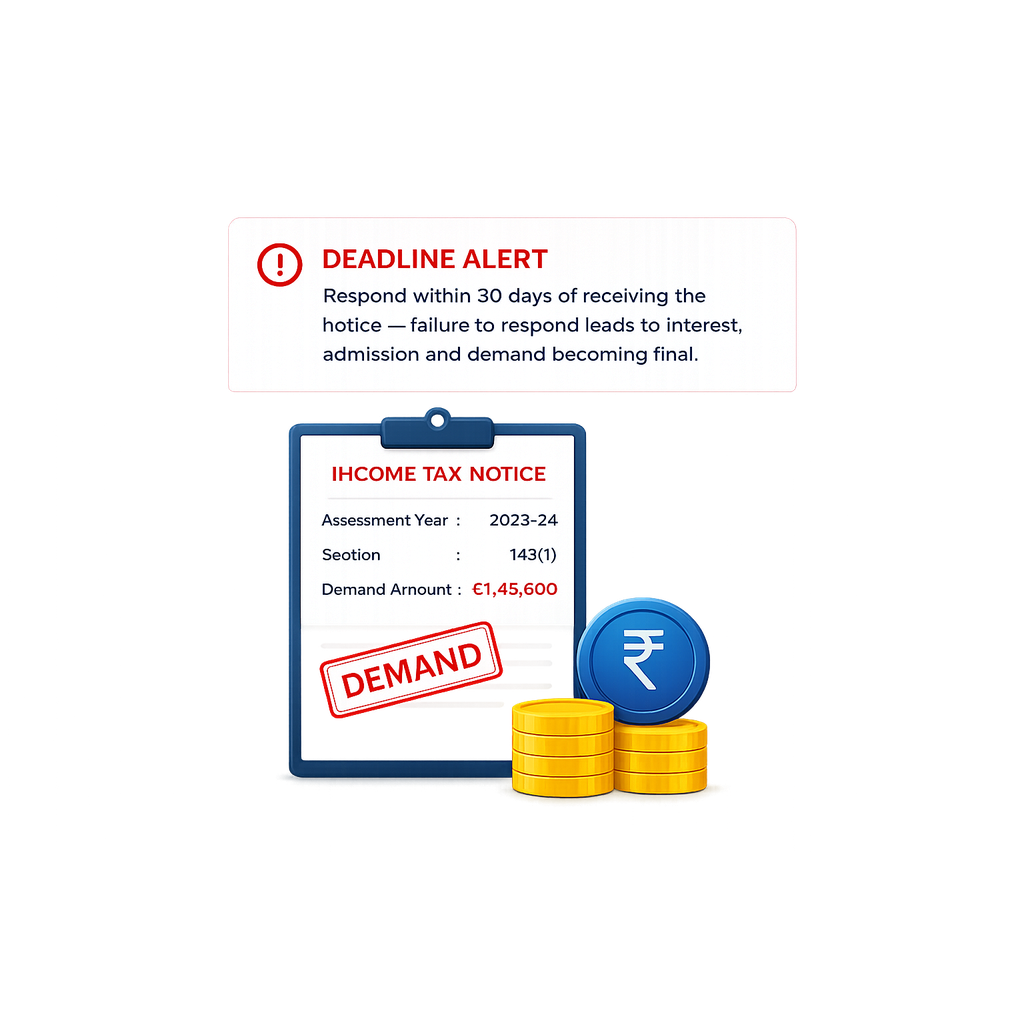
Read the notice in full and identify: the assessment year it relates to, the section under which it is issued (143(1), 143(3), 148, 156, etc.), the exact amount demanded, and the specific grounds stated.
2
Log into the Income Tax portal (incometax.gov.in) with your PAN — all notices are also posted there under ‘Pending Actions.’ Confirm the notice is genuine — some tax demand SMSs are phishing attempts. Verify only on the official portal.
3
Check Form 26AS and the Annual Information Statement (AIS) on the IT portal — compare TDS credits and income entries against what you filed. A Section 143(1) demand often arises from a TDS mismatch or an omission that can be seen in these documents.
4
Identify whether the demand is correct or contestable: if the demand is correct, pay it promptly with interest to stop further accumulation. If you disagree with the demand and are convinced that it is incorrect, prepare to file a response.
5
It is recommended to engage a Chartered Accountant or tax consultant if the amount is above ₹50,000 or if the notice is for scrutiny (143(3)) — these require professional handling.
Short-Term Steps — First 2–4 Weeks
1
For Section 143(1) intimations: if you agree with the demand — pay through the IT portal using ‘Pay Tax’ (Challan 280, Self-Assessment Tax).
Calculate interest under Sections 234A (filing delay), 234B (advance tax shortfall), and 234C (deferred installments) — these run from the original due dates and increase the total payable. Pay these simultaneously.
If you disagree with the demand — file a rectification request under Section 154 on the portal, uploading supporting documents.
For demands arising from TDS mismatch, obtain a corrected TDS certificate from the deductor and upload it with your rectification request.
Calculate interest under Sections 234A (filing delay), 234B (advance tax shortfall), and 234C (deferred installments) — these run from the original due dates and increase the total payable. Pay these simultaneously.
If you disagree with the demand — file a rectification request under Section 154 on the portal, uploading supporting documents.
For demands arising from TDS mismatch, obtain a corrected TDS certificate from the deductor and upload it with your rectification request.
2
For scrutiny assessments (143(3)): respond to the notice within the specified date through the e-proceedings section of the IT portal. Submit all documents supporting your return — bank statements, investment proofs, salary slips, Form 16.
3
Calculate interest under Sections 234A (filing delay), 234B (advance tax shortfall), and 234C (deferred installments) — these run from the original due dates and increase the total payable. Pay these simultaneously.
4
For demands arising from TDS mismatch: obtain a corrected TDS certificate (Form 16/16A) from the deductor and upload it with your rectification request.
5
Do not ignore the notice hoping it will go away — not responding to a notice will trigger recovery proceedings including attachment of bank accounts and property.
Resolution Steps — Next 1–6 Months
1
Appeal against an incorrect demand: if the Assessing Officer does not accept your rectification: file an appeal before the Commissioner of Income Tax (Appeals) — CIT(A) — within 30 days of the order.
Also, before filing the appeal, file a ‘stay of demand’ application with the Assessing Officer concerned and pay the initial deposit required by the AO (generally in the range of 10% to 20% of the amount disputed).
Also, before filing the appeal, file a ‘stay of demand’ application with the Assessing Officer concerned and pay the initial deposit required by the AO (generally in the range of 10% to 20% of the amount disputed).
2
For large or complex disputes: approach the Dispute Resolution Committee or Dispute Resolution Panel (DRP) or the Income Tax Appellate Tribunal (ITAT) at the appropriate stage.
3
The ‘Vivad se Vishwas’ scheme (or its current equivalent) offers settlement of pending disputes at a reduced liability — check the IT portal for current availability.
4
Once the demand is resolved: ensure the IT portal reflects the correct outstanding as nil. Obtain an ‘Intimation under Section 143(1)’ showing nil demand as documentary proof.
5
Update your advance tax schedule for future years: if the demand arose from shortfall in advance tax, revise your quarterly advance tax payments going forward.
Prevention — Stay Compliant, Stay Safe
✓
File your ITR on time every year — late filing attracts penalties, increases scrutiny risk, and limits your ability to carry forward losses.
✓
Reconcile your Form 26AS and AIS with your ITR before filing — most 143(1) demands arise from mismatches that a 15-minute check would have caught.
✓
Pay advance tax quarterly if your tax liability exceeds ₹10,000 — this avoids Section 234B and 234C interest.
✓
Keep all investment, income, and deduction proofs for 7 years — the IT department can issue notices for up to 6 assessment years in most cases.
✓
Use a CA for ITR filing if you have multiple income sources, capital gains, foreign income, or business income — the complexity multiplies and so does the risk of errors.
Watch Video Guide
Your Rights
Under the Income Tax Act, you have the right to be heard before any assessment is finalised (principles of natural justice). You have the right to appeal at multiple levels: CIT(A), ITAT, High Court, and Supreme Court. Interest under Section 244A is payable to you by the government on tax refunds delayed beyond specified periods. The department cannot initiate coercive recovery while an appeal is pending and a stay of demand has been granted.
Key Contacts & Portals
| Who / What | Contact / Action |
|---|---|
| Income Tax Portal | incometax.gov.in — for all notices, responses, and payments |
| IT Helpline | 1800 103 0025 (toll-free) |
| IT Aaykar Sampark Kendra | 0124-2438000 |
| Who / What | Contact / Action |
|---|---|
| CIT (Appeals) | Your jurisdictional CIT(A) — for filing appeals |
| Tax Ombudsman / CBDT | cbdt.gov.in — for grievances against tax officials |
| Chartered Accountant | ICAI member directory: icai.org — for professional assistance |