
Author name: Rakshith

Foundations of Money

Human Element of Money

Human Element of Money This closing topic addresses the gap between understanding financial concepts and actually acting on them — the domain of behavioural finance. It covers loss aversion and the disposition effect (holding losers, selling winners early), present bias/hyperbolic discounting (favouring immediate rewards over larger future ones — the direct driver of the procrastination covered in Topic 9), mental accounting (treating money differently based on its source, for better when used deliberately as in Topic 8’s envelope method, or for worse when it masks an inconsistent net financial position), and recaps herd mentality, anchoring, and overconfidence from tackl.finance’s direct-equity-risks note as patterns that extend beyond investing. We address social and cultural influences on financial decisions — framed not as errors but as real values needing explicit planning — and “money scripts,” the often-unconscious beliefs about money formed early in life. The closing message, and the thread through this entire series: design around behaviour rather than against it — automation, structured defaults, and accountability turn good decisions made once into good outcomes repeated automatically.
Foundations of Money

Common Financial Mistakes People Make

Common Financial Mistakes People Make This guide consolidates the financial mistakes that recur across nearly every income level — not from lack of knowledge, but from defaults left unexamined. It covers: skipping the emergency fund, lifestyle creep absorbing income growth, setting long-term goals without inflation-adjusting them, chasing past investment returns, relying on high-interest debt (especially credit card minimum payments), bundling insurance with investment, procrastinating on long-term saving (and the disproportionate compound-interest cost of early delays), concentrating wealth in one familiar asset class, treating tax planning as a March deadline rush, underestimating guarantor risk when co-signing loans, and neglecting wills and nominations. Each mistake connects back to a concept covered earlier in this series — the common thread being that these are all default behaviours rather than deliberate choices, and the fix is a better default, not more willpower.

Foundations of Money

Budgeting Frameworks

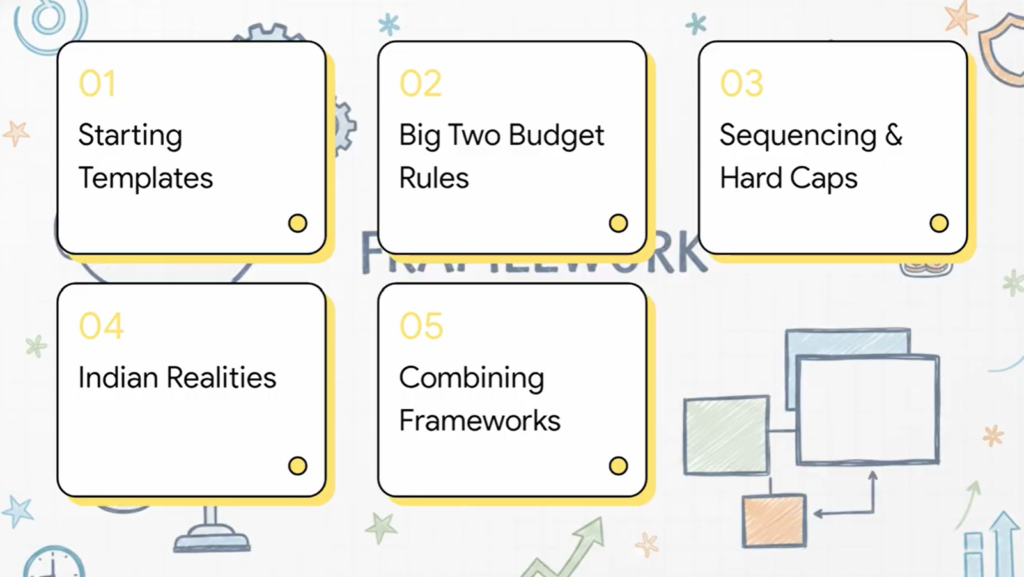
Budgeting Frameworks: Choosing a Structure That Fits This guide covers the major budgeting frameworks — templates for how to structure the planning step from Topic 7. The 50/30/20 rule (Needs/Wants/Savings) offers simplicity and a quick reference, though high housing costs in many Indian cities mean it often needs adapting rather than followed exactly. Zero-based budgeting assigns every rupee a purpose (including savings), providing completeness at the cost of more upfront effort. Pay-yourself-first and reverse budgeting both sequence savings before spending — the latter deriving the savings amount directly from goal-based calculations (as in tackl.finance’s retirement series) rather than a habitual percentage. The envelope/cash-stuffing method (and its digital “pots” equivalent) provides a hard boundary particularly useful for discretionary spending. We close with practical adaptations for Indian realities — sinking funds for lumpy festival/annual expenses, household-level budgeting for joint families, and baseline-income budgeting for irregular earners — and note that most workable budgets combine elements of several frameworks rather than following one exactly.

Foundations of Money

Basics of Budgeting

Basics of Budgeting Budgeting is the deliberate, advance version of the personal income statement introduced in Topic 6 — a plan for where income goes, rather than a record of where it went. This guide covers the basic four-step process: tracking actual spending (made easier by digital transaction trails from UPI and cards), categorising it using the fixed/variable and essential/discretionary lenses from Topic 6, planning targets informed by your broader financial goals, and reviewing without judgment to refine the next cycle. The key structural point: treating savings and investments as a planned budget line (ideally automated via SIPs) rather than whatever happens to be left over after spending — with the emergency fund as the first priority. We close with a brief look at tools — spreadsheets, apps, and the envelope method (and its digital “pots” equivalents) — with the central point that the best tool is the one you’ll actually keep using.

Foundations of Money

Your Personal Financial Statements

Your Personal Financial Statements Just as companies have an Income Statement and a Balance Sheet (covered in tackl.finance’s fundamental analysis note), individuals have direct parallels — and this guide builds both. Income (active, from ongoing effort, vs passive, from assets already owned) minus Expenses (fixed vs variable, essential vs discretionary) is your personal income statement, determining your savings rate. Assets (everything you own with value, including often-overlooked ones like your home) minus Liabilities (debt, with a “good debt vs bad debt” framing tied to compound interest from Topic 5) equals Net Worth — your personal balance sheet, and a far more complete measure of financial position than income alone. We explain how these two statements connect — your savings rate is what changes your net worth over time — and why tracking net worth periodically, as a trend rather than a single snapshot, is one of the most useful habits in personal finance.

Foundations of Money

Cost of Living & Indexation

Cost of Living & Indexation Cost of living brings inflation (Topic 3) down to the personal and local level — your actual spending pattern and location can mean your real cost-of-living increase differs meaningfully from the headline CPI figure. This guide introduces indexation — the general technique of adjusting a value over time to keep pace with a price index — and traces it through several real contexts: Dearness Allowance (which indexes pay, and the base for retirement benefits like EPF and gratuity, for many employees), the Cost Inflation Index (whose role in capital gains tax has narrowed significantly since the Finance Act 2024 reforms covered in tackl.finance’s tax series, now mainly relevant to the pre-July-2024 property grandfathering choice), inflation-indexed bonds, and everyday examples like rent escalation clauses and the “lifestyle creep” that can make a nominal salary increase feel like progress without representing any real one.

Foundations of Money

Inflation & Purchasing Power

Inflation & Purchasing Power Inflation is a sustained rise in the general price level — and its mirror image, declining purchasing power, is the reason money sitting idle quietly loses value over time, even if never spent. This guide explains how inflation is measured in India (CPI, recently rebased to 2024 with 358 items, as the primary policy measure, vs WPI; and the headline-vs-core debate), the two broad causes (demand-pull and cost-push), and India’s flexible inflation-targeting framework — the 4% CPI target with a 2–6% tolerance band, managed via the Monetary Policy Committee’s repo rate decisions, and just renewed in March 2026 for the period through March 2031. We also revisit the real-vs-nominal distinction from tackl.finance’s foundations series, and cover deflation — the less-discussed opposite of inflation, and why central banks target a small positive rate rather than zero.

Foundations of Money

The Evolution of Money

The Evolution of Money Money’s history is a sequence of solutions to the same recurring problem: making exchange, measurement, and saving more convenient. This guide traces that path — from barter and its “double coincidence of wants” problem, through commodity money (cattle, shells, precious metals) and standardised coinage, to paper money and the eventual end of the gold standard in 1971, which made today’s fiat currencies (including the rupee) possible. We cover the Indian rupee’s own journey — the RBI’s establishment in 1935 and the demonetisation episodes of 1978 and 2016 — before tracing the acceleration from cheques and cards to NEFT/RTGS/IMPS and, most distinctively, India’s UPI revolution since 2016. We close with a factual look at what’s next: the RBI’s e₹ (CBDC) pilot since late 2022, and cryptocurrency’s current (non-legal-tender, separately-taxed) status in India — and the common thread running through every step of this history.

Calculator 7 Others

Term Insurance Optimiser

Term Insurance Optimiser Calculator #25 (Life Insurance Need) tells you how much cover you need today. This optimiser goes further: it models how your insurance need evolves over time as liabilities reduce and corpus grows, and answers three questions that no standard calculator addresses: Life Stage SingleMarriedMarried with Kids Age Y 21 Y60 Y Annual Income ₹ ₹2 L₹1 Cr Existing Cover ₹ ₹0₹5 Cr Outstanding Loans ₹ ₹0₹5 Cr Number of Dependents 06 Current Annual Expenses ₹ ₹1 L₹50 L Retirement / Protection Age Y 50 Y75 Y Expected Inflation % 3%10% Existing Assets for Family ₹ ₹0₹5 Cr Annual Premium Budget ₹ ₹5 K₹2 L Recommended Cover ₹0 Additional Cover ₹0 Income Replacement Cover₹0 Loan Protection Cover₹0 Expense Protection Cover₹0 Gross Recommended Cover₹0 Existing Cover₹0 Existing Assets Adjustment₹0 Additional Cover Needed₹0 Suggested Term0 years

Calculator 7 Others

Gold vs. Equity vs. Real Estate Comparison Calculator

Gold vs. Equity vs. Real Estate Comparison Calculator Indian investors diversify across three major asset classes — gold, equity (stocks/mutual funds), and real estate — but rarely see a rigorous apples-to-apples comparison accounting for transaction costs, taxes, liquidity, and inflation. This calculator computes the post-tax, post-cost wealth generated by each asset class over a user-defined horizon, using both historical Indian CAGR benchmarks and user-customisable return assumptions. Common Inputs Investment Amount ₹ ₹1L₹1Cr Investment Horizon Y 1Y30Y Inflation Rate % 1%10% Return Assumptions Equity Return % 5%20% Gold Return % 3%15% Real Estate Return % 3%15% Costs & Tax Equity Expense / Tax Drag % 0%5% Gold Holding / Tax Cost % 0%5% Real Estate Costs % 0%8% Best Asset – Best Future Value ₹0 Equity Final Value₹0 Gold Final Value₹0 Real Estate Final Value₹0 Equity Real Return Value₹0 Gold Real Return Value₹0 Real Estate Real Return Value₹0 Best Performing Asset– Liquidity PreferenceEquity

Book an Appointment Form