
Author name: Rakshith

Personal Taxation

Monitoring & Compliance

Monitoring & Compliance: AIS, Notices, Advance Tax & Staying on the Right Side of the Line Filing your return is the start of the compliance cycle, not the end. This guide covers the data-driven tools you should check before filing — Form 26AS (tax credits), AIS (a comprehensive statement of income reported to the department from multiple sources), and TIS (a simplified summary) — along with the AIS “Feedback” mechanism for disputing incorrect entries. We cover advance tax obligations (instalments due 15% by June 15, 45% by Sept 15, 75% by Dec 15, 100% by March 15, with interest under Sections 234B/234C for shortfalls — and an exemption for senior citizens without business income), the common notices you might receive (143(1) intimation, 139(9) defective return, 142(1) inquiry, 148 reassessment) and how to respond, the shift to faceless assessment via the e-Proceedings portal, the penalty structure (234F late fee, 234A interest, 270A under/misreporting penalties up to 200%), and practical record-keeping guidance given ITR-U’s new 48-month correction window.
Personal Taxation

Wealth Creation & Capital Gains

Wealth Creation & Capital Gains: The Rules That Changed in 2024 — and What They Mean Now Capital gains taxation was overhauled by the Finance (No. 2) Act, 2024, effective from 23rd July 2024 — and these rules are now firmly in effect for FY 2025-26 filings. This guide explains the simplified two-tier holding period (12 months for listed securities, 24 months for everything else), the current rates (12.5% LTCG without indexation on most assets; equity LTCG at 12.5% above a ₹1.25 lakh annual exemption; equity STCG at 20%; debt funds taxed at slab rate regardless of holding period), and — most importantly — the grandfathering provisions: for property bought before 23rd July 2024, resident individuals/HUFs can choose the lower of 12.5% without indexation or 20% with indexation (NRIs cannot); for equity bought before 31st January 2018, the cost base resets to January 2018 fair market value. We also cover capital loss set-off rules (STCL vs both gains, LTCL vs LTCG only, 8-year carry-forward), unchanged Section 54/54EC/54F rollover exemptions, and flag recent STT rate increases for active traders to verify directly.

Personal Taxation

Filing Returns: New Forms & Processes for AY 2026-27

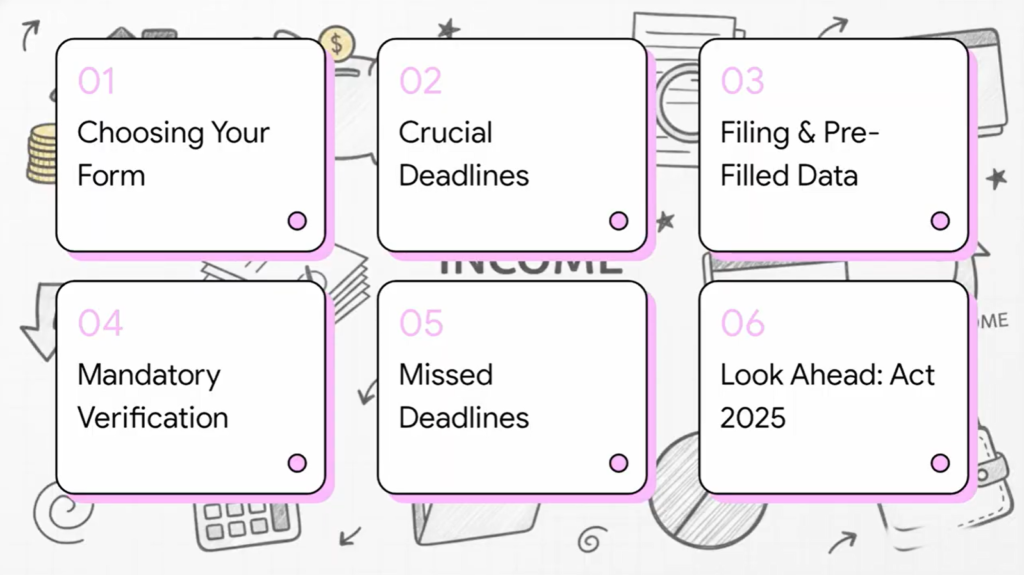
Filing Returns: New Forms & Processes for AY 2026-27 Filing season 2026 is the last cycle under the Income Tax Act, 1961 before the new Income Tax Act, 2025 takes over for FY 2026-27 onwards. This guide covers which ITR form applies to you (including ITR-1’s newly expanded scope to include limited LTCG under Section 112A), the standard due dates for AY 2026-27 (31st July for most individuals, with later dates for audit and transfer-pricing cases), how to verify — not just accept — pre-filled return data, the critical and often-missed 30-day e-verification step, and your options if you miss a deadline: revised return (Section 139(5), cleanest option), belated return (Section 139(4), with a 234F late fee), or ITR-U (Section 139(8A), now extended to a 48-month window but always increases tax liability). We close with a preview of the “Tax Year” terminology and extended revision window coming under the new Act from 2027.

Personal Taxation

Deductions & Exemptions

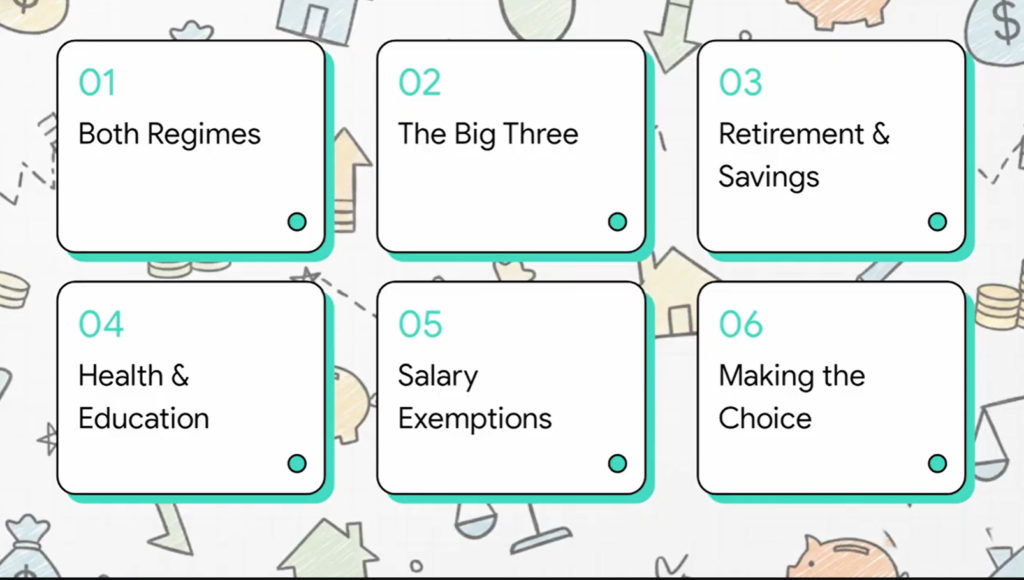
Deductions & Exemptions: The Complete Old-Regime Toolkit (and What Survives Under the New) This guide is a practical reference to every major deduction and exemption available to Indian individual taxpayers, organised by regime availability. Available under both regimes: Standard Deduction (₹75,000/₹50,000), Section 80CCD(2) employer NPS contribution (up to 14% of salary — a standout benefit that survives the new regime), 80CCH (Agniveer Corpus Fund), and the family pension deduction. Old regime only: the “big three” — Section 80C (₹1.5 lakh, covering EPF/PPF/ELSS/insurance/tuition), Section 80D (health insurance, up to ₹75,000 combined for self and senior-citizen parents), and home loan interest (₹2 lakh for self-occupied property) — plus 80CCD(1B) (₹50,000 additional NPS), 80TTA/80TTB (savings/senior interest), 80E (uncapped education loan interest), 80DD/80DDB (disability and critical illness), 80G (donations), and the salary exemptions HRA and LTA. We close with a practical three-step framework for the annual old-vs-new regime decision.

Personal Taxation

Tax Components

Tax Components: From Salary Structure to Final Tax Liability This guide breaks down two stacks of numbers every taxpayer encounters. First, your salary structure: Basic (taxable, and the base for HRA/EPF/gratuity calculations), HRA and LTA (exempt under Sections 10(13A) and 10(5), old regime only), Standard Deduction (₹75,000 new regime / ₹50,000 old regime — available to all salaried/pensioners), and perquisites including ESOPs. Second, the tax computation stack: slab-based tax → Section 87A rebate (zeroing tax up to ₹12 lakh new regime / ₹5 lakh old regime, with marginal relief) → surcharge for incomes above ₹50 lakh (capped at 25% under the new regime vs 37% under the old) → 4% Health & Education Cess → final liability, reconciled against TDS, TCS, advance tax, and self-assessment tax already paid.

Retirement Planning

Know Your ESIC Coverage

Know Your ESIC Coverage ESIC provides comprehensive medical care plus sickness, maternity, disability, and dependants’ benefits to employees earning ₹21,000/month or less (₹25,000 for persons with disabilities) — for a contribution of just 0.75% of wages (employer pays 3.25%). This guide explains what counts as “wages” for the ceiling calculation (a common source of payroll errors), the full range of benefits available, the often-misunderstood rule that benefits continue for roughly six months after an employee crosses the wage ceiling, how ESIC and private health insurance complement rather than replace each other, and how to check your own coverage via your payslip, e-Pehchan card, or the ESIC portal.

Retirement Planning

How Much Gratuity Will You Get?

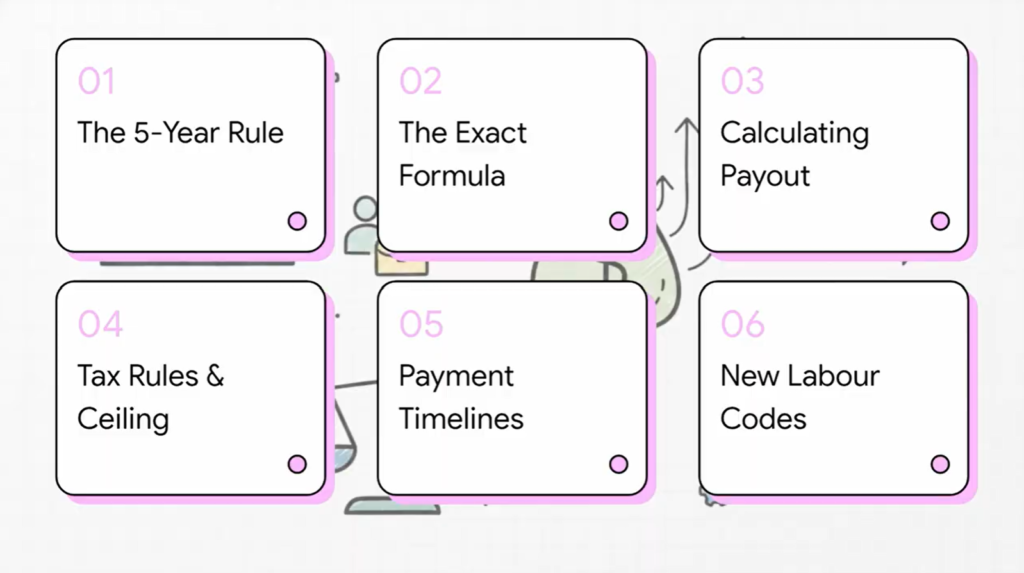
How Much Gratuity Will You Get? Gratuity is a legal entitlement, not a discretionary bonus — and the formula is simple enough to calculate yourself: (15 ÷ 26) × Last Drawn Basic+DA × Completed Years of Service, payable after 5 years of continuous service (waived for death/disability). This guide walks through worked examples, the ₹20 lakh tax-exemption ceiling (with anything above taxed at slab rate), the 30-day payment deadline with 10% interest penalty for delays, and a development worth tracking: the new Labour Codes’ “50% of CTC as wages” rule, which could increase the Basic+DA component used in this formula — and therefore future gratuity payouts — for many employees as employers adjust salary structures.

Retirement Planning

EDLI — Employees’ Deposit Linked Insurance Scheme

EDLI — Employees’ Deposit Linked Insurance Scheme EDLI is an automatic, employer-funded life insurance cover bundled with every EPF membership — at zero cost to the employee. This guide explains the payout formula (35× average monthly wages capped at ₹15,000, i.e., up to ₹5,25,000, plus a PF-balance-linked bonus of up to ₹1,75,000, for a maximum total of ₹7 lakh, with a minimum assured benefit of ₹2.5 lakh for those with 12 months continuous service), who’s covered (automatic for all EPF members, no minimum service required), and how to claim (Form 5 IF, via the registered nominee). Most importantly, it explains why this benefit so often goes unclaimed — and why keeping your EPF nomination updated and making your family aware of EDLI is one of the simplest, highest-value actions in this entire series.

Retirement Planning

Employees’ Provident Fund: Do’s and Don’ts

Employees’ Provident Fund: Do’s and Don’ts EPF is one of the most powerful retirement tools available to salaried Indians — but only if managed correctly across a career. This guide is a practical do’s-and-don’ts checklist: activate and verify your UAN and KYC (Aadhaar/PAN/bank), keep nominations updated after life events, consolidate old accounts via Form 13 when changing jobs, and periodically check your passbook against your payslip. On the don’t side: avoid withdrawing on every job change (it breaks compounding on an 8.25% tax-free instrument), don’t let accounts go dormant beyond 36 months (interest becomes taxable), fix document mismatches before they become urgent, and never assume employer contributions are being deposited without checking.

Retirement Planning

Psychology: The “Day After”

Psychology: The “Day After” Financial planning prepares you for the day you stop earning — but rarely for the identity, structure, and social changes that follow. This guide explores the well-documented “retirement shock” phenomenon, and introduces the concept of a “Life Portfolio” built on four pillars: Purpose (what replaces work’s sense of meaning), Routine (deliberate daily structure), Relationships (social connections beyond the workplace), and Health. We also cover phased/“bridge” retirement as a way to ease the transition (and reduce pressure on your corpus in early years), the often-overlooked adjustment of couples suddenly spending much more time together, and a practical “trial retirement” exercise to test your planned routine before making it permanent.

Book an Appointment Form