
Author name: Rakshith

ECONOMY

Education Inflation: The Cost of Credentialing

Education Inflation: The Cost of Credentialing In India, a top-tier education has always been viewed as the ultimate inheritance you can pass down to the next generation. However, in 2026, that inheritance carries a compounding price tag that is aggressively outstripping standard salary increments and general market inflation combined.  Before you start setting aside arbitrary monthly savings for your child’s future degree, you need to ask a much harder question: “Am I accounting for a cost baseline that doubles every seven years?”  Insulating your educational goals from compounding fees requires recognizing three core structural realities: Failing to plan for the 30% hidden overheads of entrance coaching, student housing, and maintenance gaps early on will trap you into a severe monthly savings deficit later in life.  Watch this video to leverage goal-based equity portfolios and deploy the exact timeline strategies needed to conquer education inflation.

ECONOMY

Medical Inflation: The Ultimate Wealth Threat

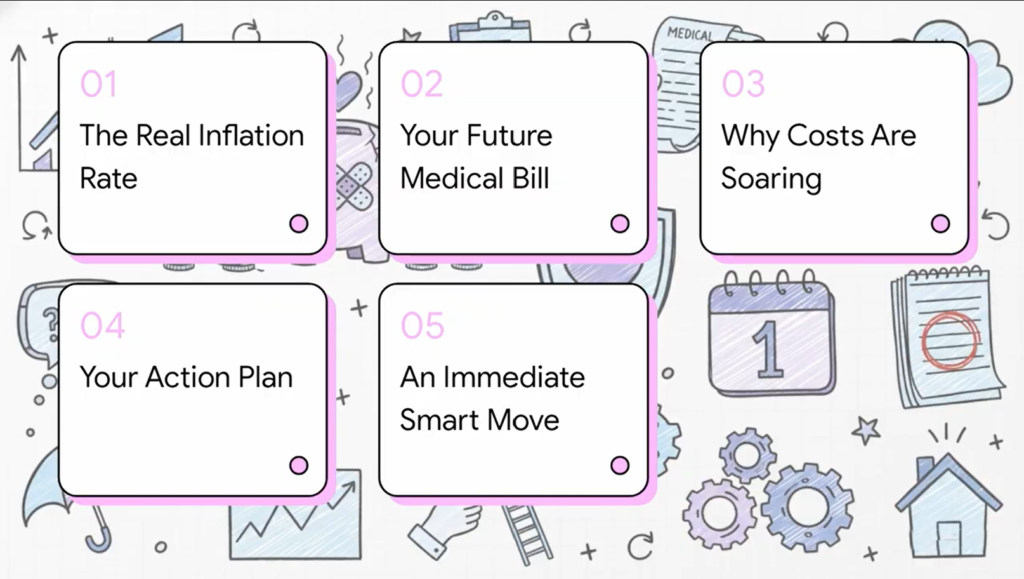
Medical Inflation: The Ultimate Wealth Threat While you track modest single-digit consumer inflation to plan your weekly grocery runs, a far more dangerous threat is compounding silently in the background. Healthcare costs in India are skyrocketing at a brutal 12% to 15% annually—nearly four times faster than the general cost of living.  Before you look at your basic 5 Lakh health policy and assume your family is secure, you need to ask a much harder question: “Can my current coverage survive the compounding future shock of healthcare technology?”  Future-proofing your life savings requires understanding the hidden forces driving healthcare costs out of reach: Treating medical planning with passive indifference is a direct path to retirement bankruptcy; a single complex surgery a decade from now can completely erase a standard lifetime nest egg.  Watch this video to master the “Super Top-Up” insurance strategy and learn how to capitalize on the 2026 GST cuts to shield your wealth from medical inflation. 

ECONOMY

Food Inflation: The Mandi vs. Your Money

Food Inflation: The Mandi vs. Your Money In developed global economies, agricultural costs are just a predictable baseline expense on a household sheet. In India, food pricing is a volatile political fuse that can instantly crash consumer sentiment and force the central bank to rewrite its entire playbook.  Before you panic-buy or stress over the next massive spike in grocery bills, you need to ask a much harder question: “Is this market disruption a temporary supply shock or a permanent structural threat?”  Navigating the volatile agricultural cycle means tracking three critical bottlenecks in the farm-to-fork journey: When the local Mandi goes on fire, major financial policy shifts follow fast; keeping an eye on agricultural storage and seasonal trends is vital to protecting your liquid cash flow.  Watch this video to understand the seasonal rhythms of food inflation and discover how to insulate your household budget from sudden supply chain shocks. 

ECONOMY

Personal Inflation

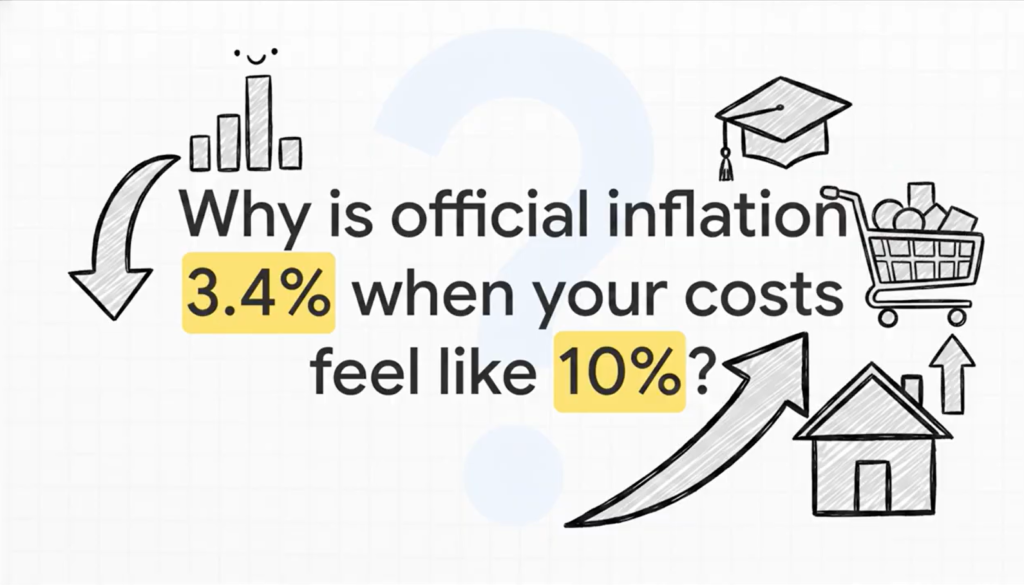
 Personal Inflation: Escaping the “Average Trap” When official data shows consumer price indexes sitting comfortably at 3.4%, but your actual monthly outlays have surged by a painful 10%, you aren’t imagining things. The national CPI is a broad-brush tool designed to measure the basic survival baseline of 1.4 billion people, heavily skewing it away from a modern lifestyle.  Before you blindly trust standard online retirement calculators to plan your long-term independence, you need to ask a much harder question: “What is my true Personal Inflation Rate?”  Escaping the statistical average trap requires auditing three brutal lifestyle premiums that national metrics ignore: Relying on generic national inflation data will leave your emergency funds and retirement corpus dangerously underfunded over time; you manage a personal economy, not a national average.  Watch this video to calculate your exact Personal Inflation Rate and learn how to construct an investment strategy that outpaces your real-world cost of living. 

ECONOMY

Open Market Operations

Open Market Operations Many investors treat debt mutual funds as completely safe, fixed-return havens, only to face a sudden shock when their portfolio’s NAV drops unexpectedly. The hidden driver behind these sudden market movements is often Open Market Operations (OMOs)—the RBI’s absolute favourite tool for controlling countrywide cash flow.  To protect your debt portfolio from unexpected hits, you must understand how the central bank adjusts the volume of the bond market.  The RBI’s open market bond trading alters your investment returns through three distinct mechanics: Open Market Operations are the RBI’s volume control; failing to match your debt fund’s duration to your actual investment horizon transforms a safe asset into an unmanaged interest rate bet.  Watch this video to decode how the RBI’s current OMO strategy impacts bond yields in 2026, and learn exactly which debt funds fit your financial timeline. 

ECONOMY

 Forex Reserves: The Nation’s Silent Bodyguard

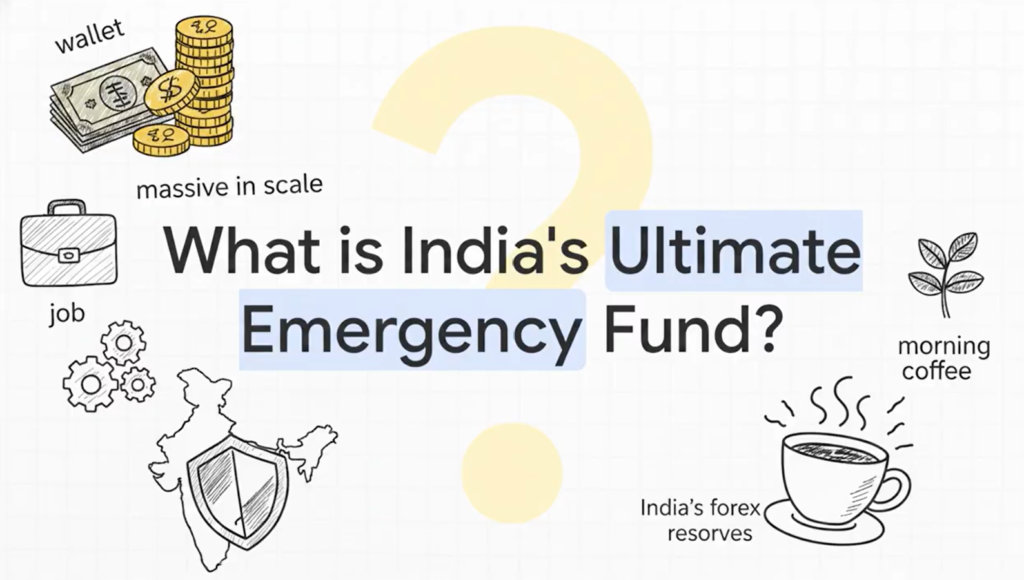
 Forex Reserves: The Nation’s Silent Bodyguard Just as a smart household maintains an emergency fund to cover unexpected shocks, a country builds a multi-billion-dollar war chest to insure itself against global financial accidents. Clocking in at a robust $697.12 billion in April 2026, India’s foreign exchange reserves serve as the ultimate defence mechanism for your standard of living.  Instead of viewing these massive reserves as idle cash, you must recognize them as an active shield protecting your daily purchasing power.  This national insurance policy protects your personal finances through three critical components: A sudden drop in headline forex reserves isn’t a sign of national failure; it means your financial bodyguard is actively absorbing a global shockwave so your household budget doesn’t have to.  Watch this video to understand the anatomy of India’s 2026 war chest and learn how central bank gold accumulation signals long-term shifts in the global economy.

ECONOMY

Currency Markets: The RBI’s Invisible Shield

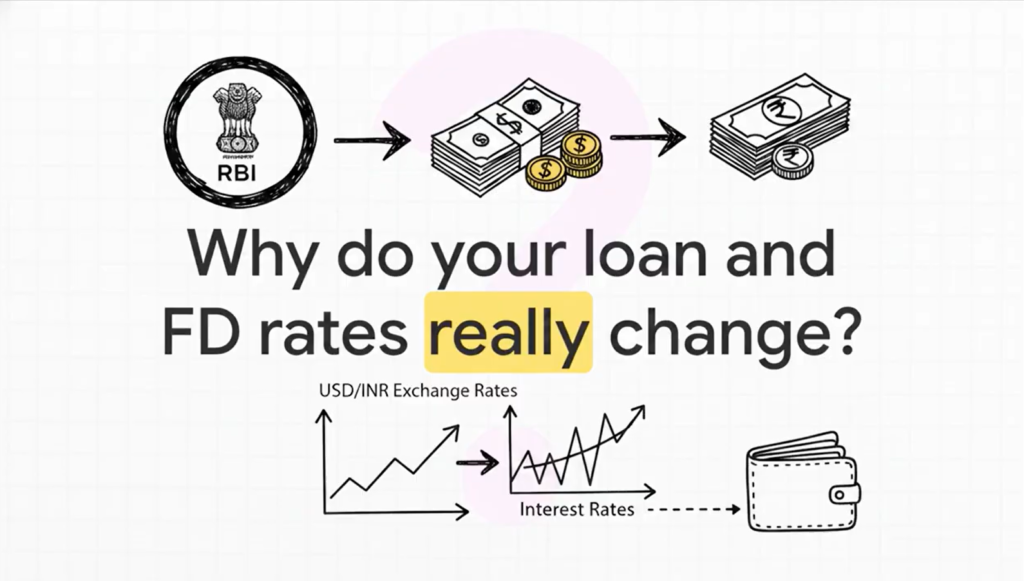
Currency Markets: The RBI’s Invisible Shield Most people think the RBI’s currency interventions are just about maintaining a specific nominal target for the Indian Rupee against the US Dollar. In reality, the central bank cares purely about managing wild volatility—and their massive institutional trades directly dictate what you pay for retail loans or earn on your savings.  Understanding how the RBI defends the currency is the secret to predicting domestic credit conditions before they hit your personal wallet.  The central bank’s currency market operations trigger a powerful chain reaction across the domestic banking system: Your home loan interest rate isn’t just about local factors; if global currency shifts force the RBI to defend the rupee, expect tighter domestic credit conditions to follow within weeks.  Watch this video to discover how the RBI’s dollar trades impact your everyday finances and learn to read currency headlines like an institutional investor.

ECONOMY

Reverse Repo, SDF, MSF

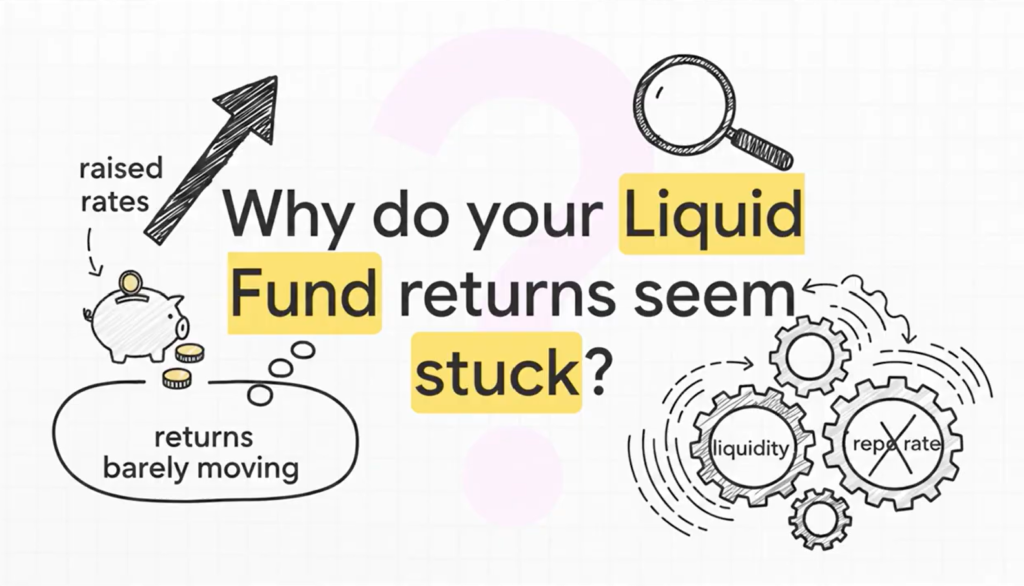
Reverse Repo, SDF, MSF While the headline repo rate captures all the mainstream media attention, the true return on your short-term cash is actually governed by a hidden 50-basis-point corridor. Run by the RBI, this system dictates why your “safe” liquid mutual funds can feel stuck even when headline interest rates look highly attractive.  To unlock better returns on your idle cash, you must look past the anchor rate and understand the boundaries of the Liquidity Adjustment Facility.  The returns on your short-term debt investments trade within the space of three institutional pillars: Your liquid mutual fund is not a fixed-return product; failing to monitor systemic liquidity shifts means settling for basement yields when you could be capturing short-term return spikes.  Watch this video to map out the 2026 liquidity corridor and learn exactly how to manage your short-term cash between liquid and overnight buckets. 

ECONOMY

Interest Rate Cycles

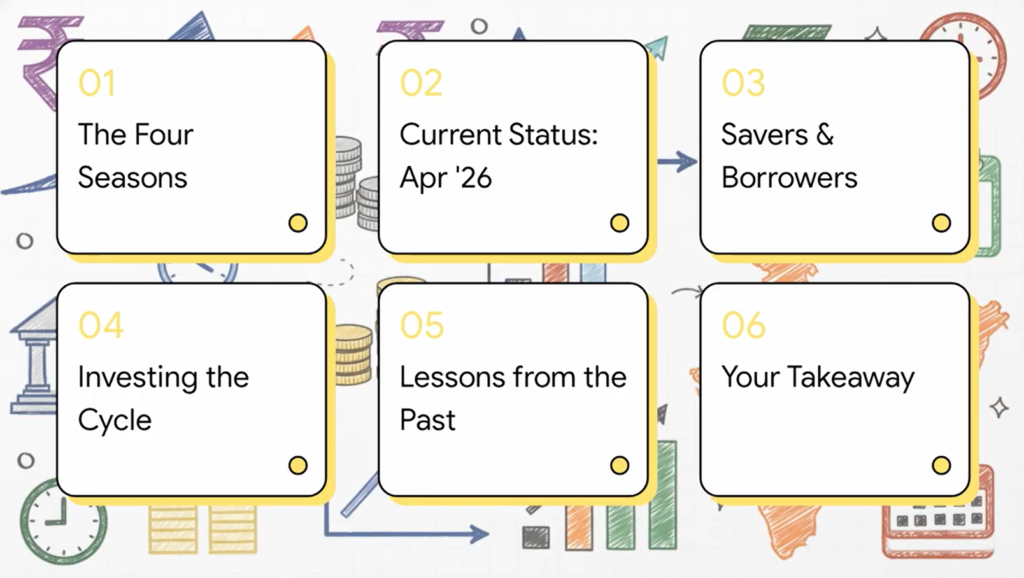
Interest Rate Cycles Interest rates act like a massive macroeconomic pendulum, swinging predictably between inflation-cooling upswings and growth-focused downswings. In early 2026, the Indian market transitioned away from a high-interest regime of 6.5%, entering a stable, 5.25% neutral pause phase.  Instead of trying to guess the absolute bottom or top of the market, you must learn to position your assets according to the current cyclical season.  Maximizing your wealth through this interest rate cycle requires understanding three core strategic pivots: Never attempt to perfectly time the macroeconomic pendulum; executing your wealth strategy in disciplined tranches ensures you win no matter which way the cycle swings next.  Watch this video to learn the exact playbook for balancing fixed deposits, mutual funds, and loan prepayments during this 2026 interest rate pause. 

ECONOMY

Purchasing Power Parity

Purchasing Power Parity Looking at a market ticker shows the US Dollar trading at roughly ₹93 in April 2026, making the Indian currency look weak on the global stage. However, that nominal exchange rate completely misses the “Lifestyle Rate”—what that money actually buys you in a Mumbai market versus a New York deli.  To understand the real size of your global wealth, you must stop looking through the lens of nominal airport exchange rates and look at Purchasing Power Parity (PPP).  The gap between what a currency is worth on the stock ticker and its real local strength is defined by three factors: Don’t be blinded by foreign currency multipliers; a high-nominal foreign salary often buys a lower-quality lifestyle than strategic rupee deployment inside India’s internal economy.  Watch this video to learn how to arbitrage the PPP gap as an investor, freelancer, or career professional in 2026. 

Book an Appointment Form