Government Schemes

Government Schemes

Ayushman Bharat Pradhan Mantri Jan Arogya Yojana (AB PM-JAY)

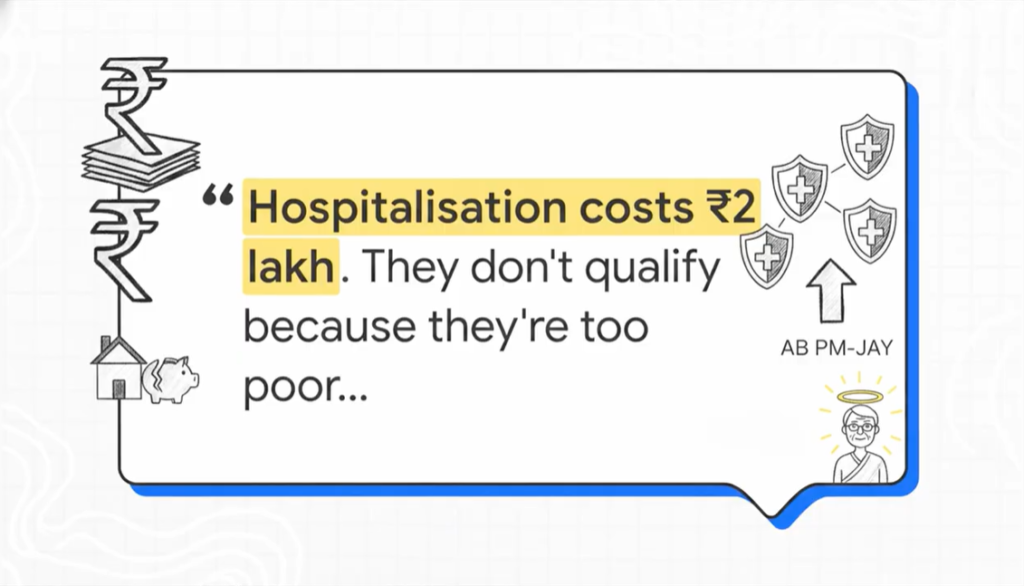
Ayushman Bharat Pradhan Mantri Jan Arogya Yojana (AB PM-JAY) AB PM-JAY (launched 23 September 2018) is the world’s largest publicly funded health insurance scheme, covering approximately 12 crore families with over 42 crore Ayushman Cards issued. It provides ₹5 lakh per family per year of cashless, paperless hospitalisation cover (secondary and tertiary care, 1,929+ treatment packages) at 32,320+ empanelled hospitals across India, with full portability, pre-existing conditions covered from day one, three-day pre-hospitalisation and 15-day post-discharge cover, and no cap on family size. Eligibility for the core scheme is SECC 2011-based (six deprivation markers in rural, eleven occupational categories in urban areas). A landmark 2024 expansion — Ayushman Vay Vandana Yojana (AVVY), launched 29 October 2024 — extends PM-JAY to all Indian citizens aged 70+, regardless of income or SECC status. Existing PM-JAY families with 70+ members get an additional exclusive ₹5 lakh/year top-up for those seniors (up to ₹10 lakh household total); non-SECC seniors get an individual ₹5 lakh/year cover via Aadhaar e-KYC self-enrolment on the Ayushman App. CGHS/ECHS holders must choose between those schemes and AVVY; private insurance holders can use AVVY additionally. As of March 2026: 3.4 crore+ seniors enrolled, ₹4,200+ crore in claims authorised (primarily cataract, knee replacement, cardiac, dialysis). Key gap: OPD costs not covered.
Government Schemes

Kisan Credit Card

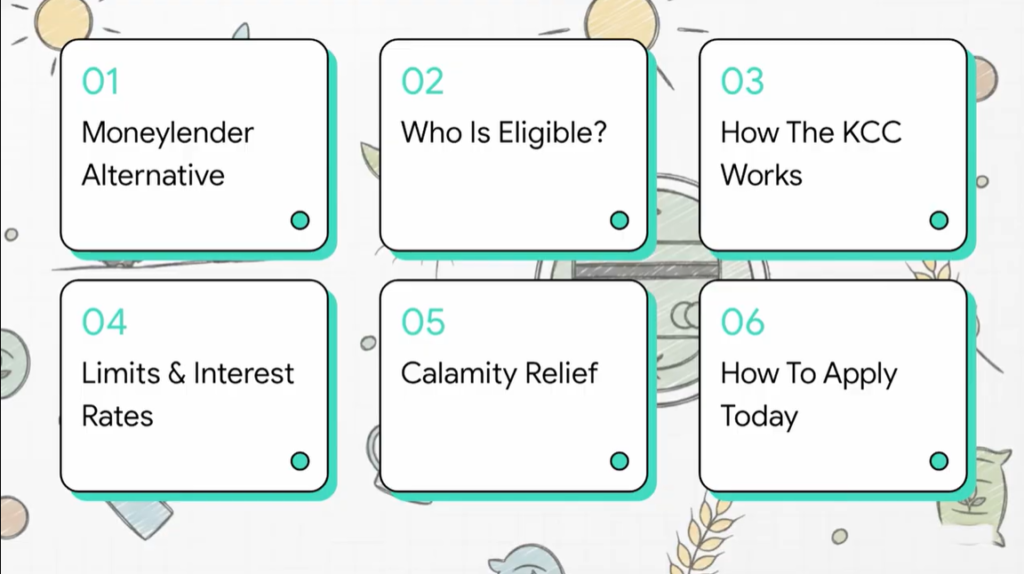
Kisan Credit Card The Kisan Credit Card (KCC), launched in 1998 by NABARD, provides revolving cash credit for short-term agricultural and allied-activity expenses at subsidised rates, through any commercial bank, RRB, Small Finance Bank, or cooperative bank. Under the Modified Interest Subvention Scheme (MISS), the government provides 1.5% interest subvention to banks, bringing the farmer’s rate to 7%; an additional 3% Prompt Repayment Incentive (PRI) for timely repayment brings the effective rate to 4% per annum. Budget 2025-26 raised the crop loan limit eligible for MISS from ₹3 lakh to ₹5 lakh, and the fisheries/animal husbandry limit from ₹2 lakh to ₹5 lakh. Effective January 2025, the collateral-free credit limit was raised from ₹1.6 lakh to ₹2 lakh per borrower. KCC operates as a 5-year revolving credit line (annually reviewed), repaid from harvest proceeds, with a RuPay debit card for ATM/POS access and PMFBY insurance bundled. For natural calamities, outstanding KCC balances can be converted to term loans with interest relief for up to 1 year (extendable to 5 years for severe disasters). Extended to fisheries and animal husbandry since 2018-19. As of 2025: approximately 7.72 crore operative KCC accounts with over ₹10 lakh crore outstanding.

Government Schemes

Affordable Rental Housing Complexes Scheme (ARHC)

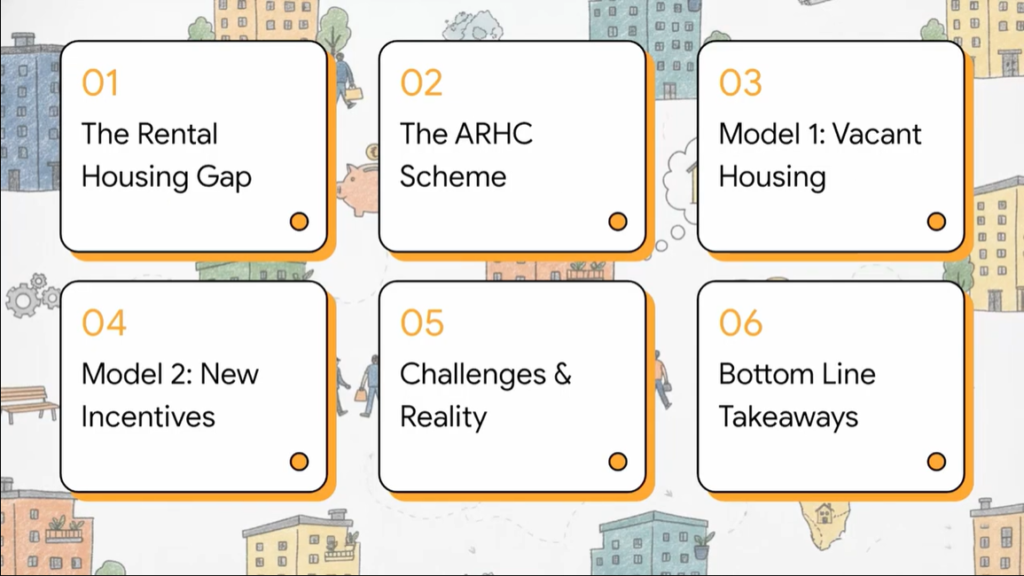
Affordable Rental Housing Complexes Scheme (ARHC) The Affordable Rental Housing Complexes (ARHC) scheme, launched in May 2020 under Atmanirbhar Bharat as a sub-scheme of PMAY-Urban, addresses the acute gap in formal rental housing for urban migrants, industrial workers, and the urban poor. Unlike most GoI housing schemes focused on ownership, ARHC explicitly targets the rental market. Two models operate: Model 1 converts existing vacant government-funded housing stock (from JNNURM/RAY/PMAY) into rental complexes via 25-year concessionaire arrangements with ULBs setting rents; Model 2 incentivises public/private entities to build new ARHC units on their own land through a Technology Innovation Grant, additional FAR/FSI, priority sector lending classification for construction loans, Section 80-IBA income tax exemptions, and GST relief. Target beneficiaries include industrial workers, students, economic zone workers, migrants, and the urban poor generally. This note provides an honest assessment: Model 1 has faced practical barriers (location, quality, legal complications in vacant stock), and Model 2 has seen limited private uptake despite incentives, making ARHC’s overall scale substantially below its 2020 ambition. Availability is geographically uneven; interested individuals and employers should check with their local ULB or state PMAY nodal agency for projects in their area.

Government Schemes

Pradhan Mantri Fasal Bima Yojana (PMFBY)

Pradhan Mantri Fasal Bima Yojana (PMFBY) PMFBY (launched 2016, replacing NAIS/MNAIS) is India’s flagship crop insurance scheme — the world’s largest by enrolments — covering all farmers (including sharecroppers and tenant farmers) growing notified crops, at capped farmer premiums of 2% (Kharif food/oilseed), 1.5% (Rabi food/oilseed), and 5% (commercial/horticultural), with the balance subsidised by Centre and states. Made voluntary for all farmers (including loanee farmers) from February 2020. Coverage spans prevented sowing, standing crop losses, post-harvest (up to 14 days), and localised calamities — with wild animal attacks and paddy inundation added as new add-on covers from Kharif 2026. Claims are area-based for standing crop (via Crop Cutting Experiments) and field-level for localised losses (72-hour reporting via app/Kisan Rakshak helpline 14447), paid via DBT. Key recent reforms: 12% per annum penalty on insurers for delayed claim payments (from Kharif 2024) and mandatory state escrow accounts for premium share deposits (from Kharif 2025) — both addressing historically poor claims timeliness. Total claims disbursed over the scheme’s life: over ₹1,72,000 crore against ₹34,500 crore in farmer premiums.

Government Schemes

Aam Aadmi Bima Yojana (AABY)

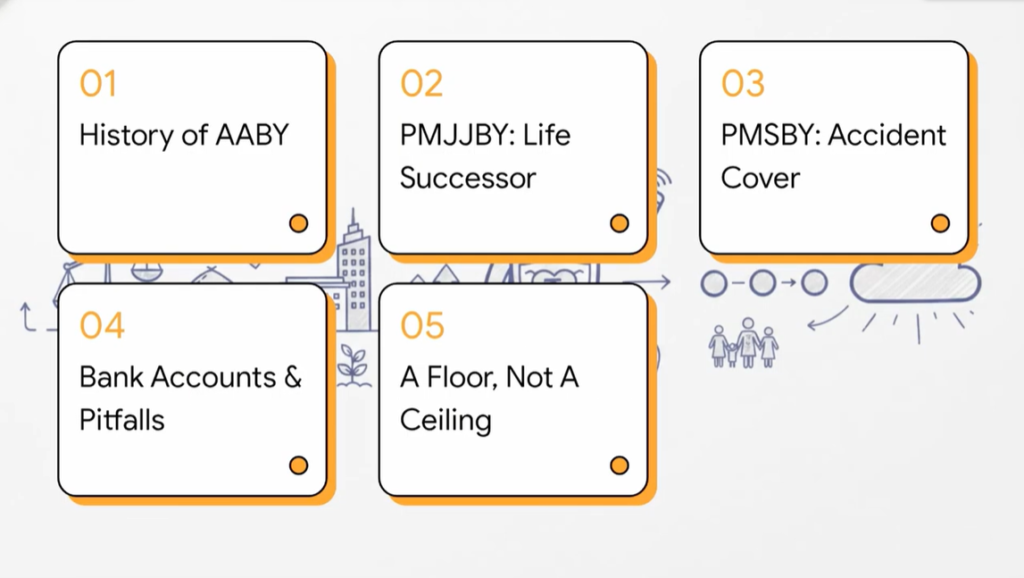
Aam Aadmi Bima Yojana (AABY) Aam Aadmi Bima Yojana (AABY), launched in 2007 for rural landless households and unorganised-sector workers (₹30,000 natural death / ₹75,000 accidental death cover at a ₹200/year subsidised premium via LIC), was merged into PMJJBY and PMSBY with effect from 1st June 2017 and is no longer open for new enrolments — this note covers that history briefly before focusing on its two successors. PMJJBY provides ₹2 lakh any-cause life cover for ages 18–50 (renewable to 55), while PMSBY provides ₹2 lakh accidental death/total disability cover (₹1 lakh for partial disability) for ages 18–70 — both operate via annual bank-account auto-debit at minimal premiums, with a common pitfall being redundant enrolment (and premium deduction) across multiple bank accounts for the same person. We note the September 2025 GST exemption on health/term insurance as relevant context, and frame PMJJBY/PMSBY as a low-cost baseline of protection that most individuals with meaningful dependents or liabilities should supplement with adequately-sized private term insurance, covered elsewhere in tackl.finance’s insurance notes.

Government Schemes

MUDRA

MUDRA Small businesses are the backbone of the economy, yet they struggle the most for capital. Pradhan Mantri Mudra Yojana (PMMY) provides collateral-free loans of up to ₹10 Lakhs to help micro-enterprises grow. Watch this video to learn how to prepare a “Project Report” that makes bank managers say “Yes” to your loan.

Government Schemes

Pradhan Mantri Awas Yojana – Grameen (PMAY – G)

Pradhan Mantri Awas Yojana – Grameen (PMAY – G) In rural India, a “pucca” house is the foundation of dignity and safety. Pradhan Mantri Awas Yojana – Gramin (PMAY-G) provides financial assistance of up to ₹1.30 Lakhs to help houseless families build a permanent home. Watch this video to see the “Construction Milestones” you need to reach to trigger your government payments.

Government Schemes

Pradhan Mantri Jan Arogya Yojana (PMJAY)

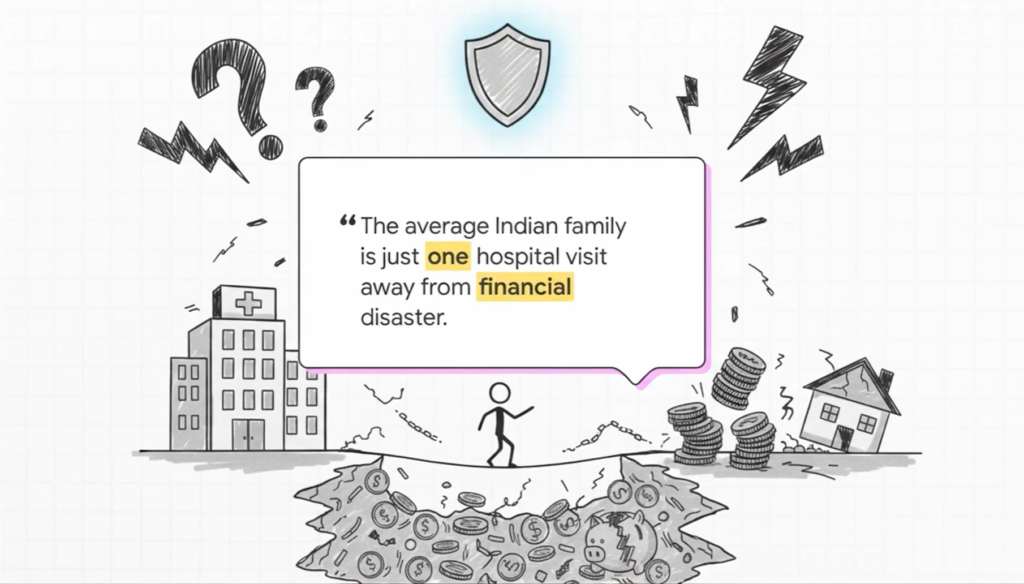
Pradhan Mantri Jan Arogya Yojana (PMJAY) A single hospital visit can push a middle-class family into poverty. Pradhan Mantri Jan Arogya Yojana (PM-JAY) is the world’s largest health assurance scheme, providing ₹5 Lakhs per family, per year for life-saving treatments. Watch this video to check your eligibility and learn how the “Ayushman Card” can be your family’s most valuable asset.

Government Schemes

Pradhan Mantri Jeevan Jyoti Bima Yojana (PMJJBY)

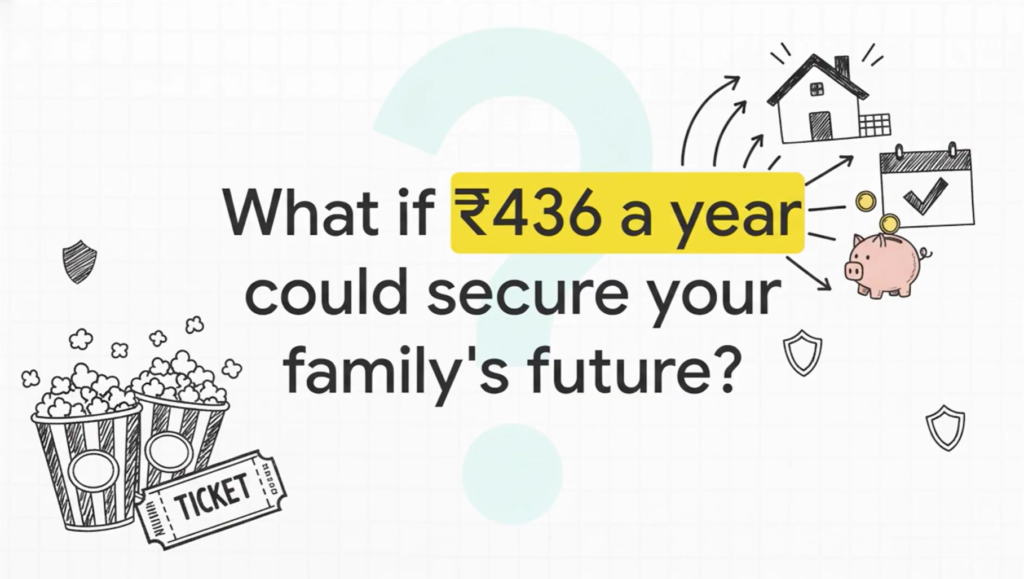
Pradhan Mantri Jeevan Jyoti Bima Yojana (PMJJBY) Accidents don’t give warnings, but they can be financially neutralized. The Pradhan Mantri Suraksha Bima Yojana (PMSBY) offers a ₹2 Lakh accidental death and disability cover for just ₹20 per year. That is less than the cost of a single cup of tea to secure your family’s future against the unexpected. Watch this video to learn the exact steps to enroll and why every member of your family needs this ₹20 safety net today.

Book an Appointment Form