
Author name: Rakshith

ECONOMY

Urban-Rural Divide: Which India Are You Living In?

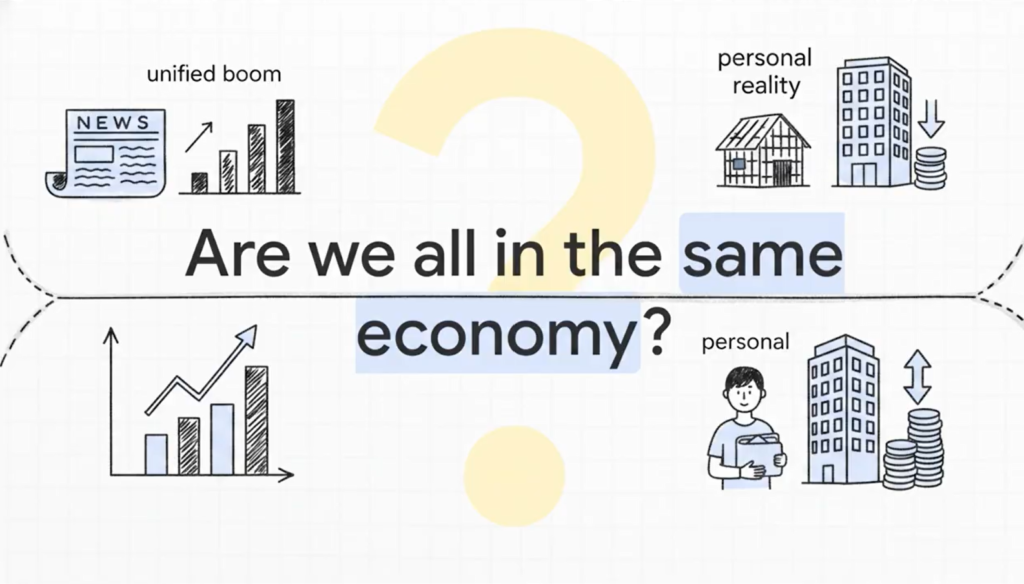
Urban-Rural Divide: Which India Are You Living In? The broad national GDP and stock market headlines frequently paint a single uniform picture that completely masks a stark geographical fracture. The Indian economic landscape remains split into two distinct realities, operating on completely separate structural gears moving at vastly different speeds.  Before you project your multi-year financial goals using generalized national economic indices, you need to ask a much harder question: “Am I tailoring my asset strategy to the specific economic speed limits of my geography?” Bridging the geographical divide requires measuring three major divergent factors: Staying locked inside a slow-growth, traditional structural gear destroys your income trajectory, forcing you to accept an invisible pay cut despite your personal effort.  Watch this video to navigate the K-shaped geographical divide and learn how to align your career and capital with high-velocity sectoral tailwinds. 

ECONOMY

Insurance as Investment: A Losing Proposition

Insurance as Investment: A Losing Proposition Mixing life protection with wealth growth inside an opaque endowment plan or ULIP remains the single biggest financial clog in the middle-class pipeline. These black-box financial products anchor onto deep consumer emotions to deliver returns that fail to match the compounding velocity of the open market.  Before you pay your next heavy recurring insurance premium, you need to ask a much harder question: “Am I subsidizing the insurance company’s corporate growth at the direct expense of my retirement?” Unclogging your insurance pipeline requires evaluating three hidden financial blockages: Relying on investment-linked insurance leaves your family with inadequate life cover and traps your capital behind rigid, long-term exit penalties.  Watch this video to execute the ultimate “Separate to Win” strategy and discover how a pure term plan paired with direct index funds doubles your long-term wealth.

ECONOMY

Government Securities: Should Retail Investors Buy G-Secs?

Government Securities: Should Retail Investors Buy G-Secs? For retail savers exhausted by the strict five-lakh protection limit governing standard bank deposits, direct institutional access offers an elite alternative. The RBI Retail Direct portal opens a pipeline to the safest asset class in the entire country, completely backed by the absolute credit of the state. Before you route your emergency reserves or fixed capital into a standard commercial savings pool, you need to ask a much harder question: “Do I understand the inverse price-yield seesaw that impacts my risk-free assets?” Deploying a direct sovereign asset strategy requires analysing your portfolio’s boundaries: Treating absolute principal safety as a substitute for real purchasing power growth destroys options, locking your capital into an asset that can run in place against your personal inflation baseline.  Watch this video to master the mechanics of buying G-Secs directly and discover how to deploy them effectively alongside low-cost index funds.

ECONOMY

 How Small Savings Rates Are Fixed By The Government?

 How Small Savings Rates Are Fixed By The Government? For millions of conservative households, the quarterly yield announcements for stable schemes like the Public Provident Fund (PPF) serve as a vital financial pulse. Far from being random numbers, these fixed returns are tethered directly to the underlying pipes of the sovereign bond market.  Before you commit your multi-year capital to rigid, long-term savings instruments, you need to ask a much harder question: “Am I tracking the mathematical formula that dictates my real-world purchasing power?” Decoding your guaranteed interest returns requires tracking three structural pillars: Chasing fixed percentages while ignoring personal inflation traps your capital, converting a nominal financial victory into a real-world loss of purchasing power.  Watch this video to audit the lock-in periods of your small savings assets and learn how to construct a portfolio built for true economic growth. 

ECONOMY

Retrospective Taxation

Retrospective Taxation Financial planning relies fundamentally on a predictable rulebook where transactions are executed based on laws known at the absolute start. Retrospective taxation acts as a sudden, highly controversial systemic glitch, granting the state power to reach back in time and rewrite the nominal tax burden of settled capital moves.  Before you execute long-term capital allocations based on narrow technical loopholes, you need to ask a much harder question: “Does my portfolio possess the resilience alpha needed to survive a retrospective rule change?” Insulating your long-term wealth from rearview-mirror surprises requires understanding policy boundaries: Building long-term wealth on the nominal sand of a hyper-technical tax loophole destroys your options when the referee decides to retroactively change the score.  Watch this video to build a policy-resilient portfolio strategy and discover how to incorporate an exact risk buffer into your long-term wealth calculations. 

ECONOMY

 Taxes That Affect NRIs

 Taxes That Affect NRIs International taxation functions as an invisible global turnstile where your net asset exposure is dictated entirely by your physical days of residency rather than your passport citizenship. For non-resident Indians managing capital across borders, stepping over specific physical thresholds can instantly alter how the state searches and taxes your global wealth.  Before you plan your next extended domestic stay or execute an international property remittance, you need to ask a much harder question: “Am I tracking the exact residency rules that safeguard my global income from a double toll?” Navigating the global tax turnstile requires maintaining strict cross-border compliance across three areas: Operating under the zero-tax-zero-file fallacy destroys your financial data trail, trapping your locked capital inside banks when attempting future cross-border remittances.  Watch this video to master your cross-border currency profile and learn how to navigate the global tax turnstile with flawless documentation. 

ECONOMY

Taxes That Affect Entrepreneurs

Taxes That Affect Entrepreneurs The landscape for building and scaling a venture in India has undergone a massive structural refit to optimize corporate ease of doing business. Major historical regulatory roadblocks have been systematically dismantled to ensure that the domestic engine of innovation can run without the drag of unnecessary litigation.  Before you map out your venture’s next capital raise or structure equity incentives for talent, you need to ask a much harder question: “Is my startup properly rigged to utilize the state’s modern safe harbours?” Fuelling your venture’s growth tank requires mastering the new startup tax architecture: Failing to secure formal DPIIT recognition leaves your startup’s cash flows completely unprotected against minimum alternate taxes and dry tax crunches.  Watch this video to decode the entrepreneur’s tax matrix and learn how to optimize your capital structure for a post-2025 startup ecosystem. 

ECONOMY

New Tax Regime vs. Old

New Tax Regime vs. Old Choosing between the custom build of the Old tax regime and the passive convenience of the New framework is one of the most critical structural choices for your annual income. As state policies aggressively position the simplified slabs as the default gear for the economy, your net disposable surplus hangs directly in the balance.  Before you blindly opt for passive convenience or stack arbitrary deduction receipts, you need to ask a much harder question: “What is the exact mathematical breakeven point that dictates my real salary?” Selecting the optimal tax vehicle means running a precise breakeven analysis across three strategic factors: Failing to mathematically audit your tax regime every budget cycle creates a silent cash drain, transforming nominal raise celebrations into an invisible pay cut.  Watch this video to analyse your custom deduction bucket and learn how to maximize your after-tax wealth between active management and automated tracking. 

ECONOMY

The New Indian Direct Tax Code

The New Indian Direct Tax Code The implementation of the Income Tax Act, 2025 marks a tectonic structural overhaul of India’s legacy tax framework, completely replacing the archaic 1961 manual as of April 1, 2026. By merging financial and assessment years into a single unified “Tax Year,” the code eliminates the traditional time-lag illusion to boost baseline filing clarity.  Before you structure your asset allocations this tax year, you need to ask a much harder question: “Is my legacy financial strategy compatible with a modern, self-driving tax engine?” Updating your financial roadmap requires navigating three major tax code consolidations: Trying to manage your modern 2026 income using an outdated tax mindset destroys options, transforming legacy deductions into unexpected post-tax wealth leaks.  Watch this video to update your tax firmware for the 2025 era and learn exactly how to calculate your real break-even points across equities, buybacks, and real estate.

ECONOMY

Geopolitics and Your Portfolio

Geopolitics and Your Portfolio While a stable geopolitical landscape serves as the quiet baseline of economic growth, unexpected international conflicts introduce sudden, massive capital shifts. A standoff across distant shipping corridors functions as an immediate gravity shift for global commodity prices and your personal net worth.  Before you panic-sell your mutual fund units during a distant international crisis, you need to ask a much harder question: “Am I looking at a temporary, mood-driven market shock or a permanent collapse of company health?” Insulating your portfolio from international market earthquakes requires managing three systemic fault lines: Letting global panic dictate your short-term investing strategy destroys options; building a resilient portfolio requires holding structured currency insurance and gold anchors.  Watch this video to build a tectonically resilient asset model and learn how to identify earthquake-proof corporations with true pricing power.

Book an Appointment Form