
Author name: sreegesh@insightdrive.xyz

Bank Accounts

Accounts for Non-Residents

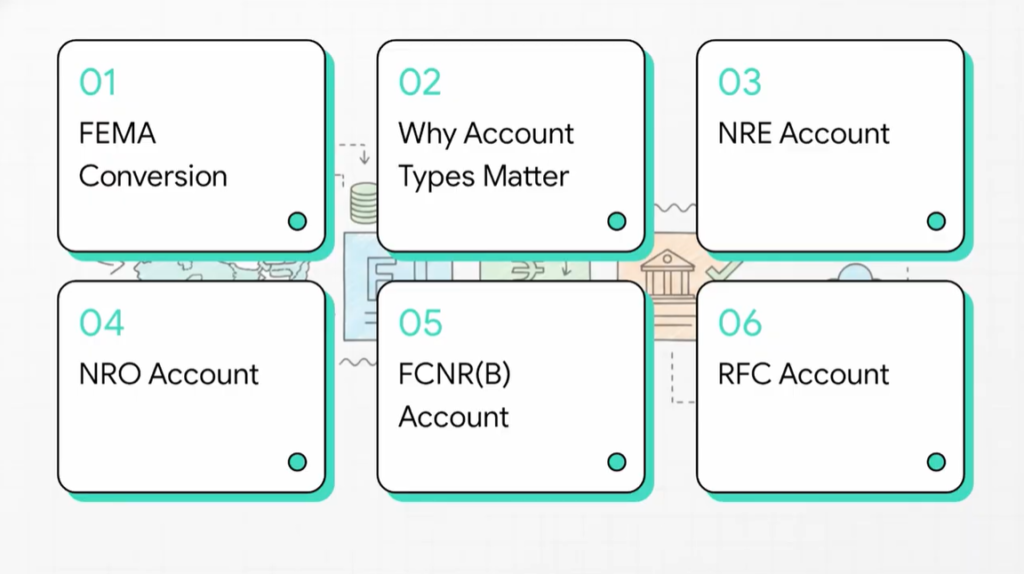
Accounts for Non-Residents: NRE, NRO, FCNR & RFC NRIs and PIOs/OCIs primarily use three account types, each answering a different question: NRE (rupee-denominated, holds foreign-earned income, fully repatriable, tax-exempt interest, but carries INR exchange rate exposure), NRO (rupee-denominated, holds India-sourced income and redesignated resident funds, repatriation capped at USD 1 million/year with CA-certified Form 15CB and Form 15CA, interest fully taxable under Section 195 with DTAA relief potentially available), and FCNR(B) (a foreign-currency-denominated term deposit only, fully repatriable and tax-exempt like NRE but without INR exchange rate exposure, available in major currencies for 1–5 year tenures). We also cover RFC accounts — for returning NRIs to hold foreign currency assets as residents without immediate conversion — and the often-missed FEMA requirement to redesignate resident accounts to NRO (or appropriately open NRE/FCNR) at the point residential status changes, rather than continuing to operate a resident account after becoming an NRI.

Bank Accounts

Safe-Deposit Lockers

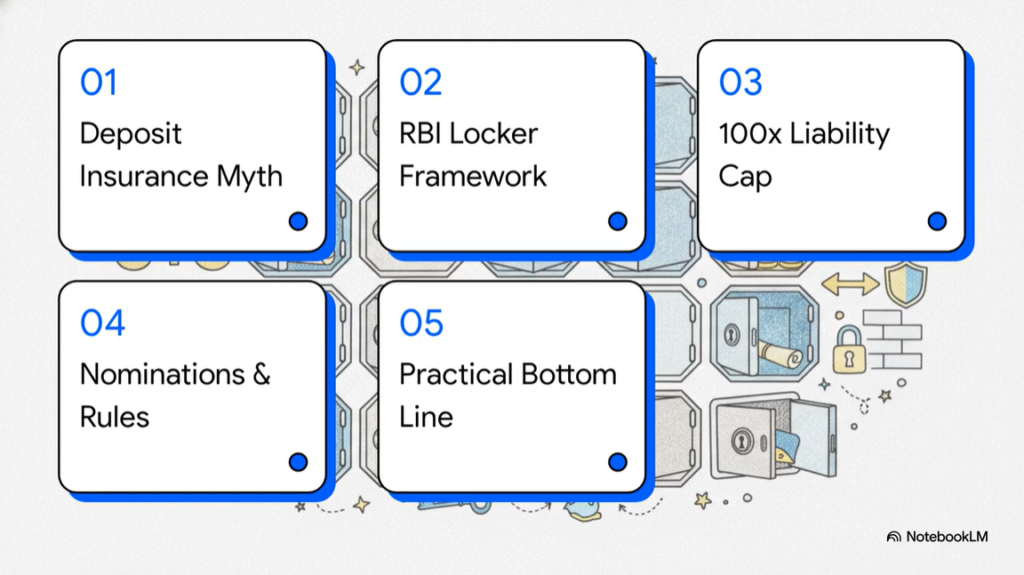
The Vault: Safe-Deposit Lockers Safe-deposit lockers are rented storage compartments — not deposits — governed by RBI’s significantly revised 2021 framework, phased in through 2023. This guide starts with the most important correction: DICGC’s ₹5 lakh deposit insurance has nothing to do with locker contents, which fall under an entirely separate (and more limited) bank liability framework. We cover what changed under the revised rules — standardised IBA-model agreements with no “unfair terms,” a ban on forcing customers to buy other products (like FDs) as a condition of locker allotment, and branch-wise vacancy transparency. On liability: banks are responsible for losses from fire, theft, burglary, and employee fraud (capped at 100 times the annual rent), but not liable for natural calamities/“Acts of God” absent their own negligence — leaving a meaningful gap that locker-content insurance can address. We cover mandatory nomination (with a 15-day claim settlement timeline on death, distinct from a will’s determination of ownership), the 7-year inoperative-locker rule and the due-process path it gives banks, prohibited items, access logging/CCTV requirements, and practical points on rent structure and maintaining your own contents inventory.

Bank Accounts

Fixed Deposits: The Strategic Asset

Fixed Deposits: The Strategic Asset A Fixed Deposit is a lump-sum, fixed-tenure, fixed-rate bank deposit — but several structural choices within it are often made by default rather than deliberately. This guide covers cumulative (compounding, paid at maturity — suited to accumulation) vs non-cumulative (periodic interest payouts — suited to income needs) FDs, what premature withdrawal actually costs (a recalculated lower-tenure rate plus a typical 0.5–1 percentage point penalty), and loans/overdrafts against FDs (often up to 90–95% of value, at a small spread over the FD rate) as a far cheaper alternative to breaking an FD for temporary liquidity needs. We cover senior citizen rate premiums and their interaction with the Section 194A TDS thresholds from Topic 3, the 5-year Section 80C tax-saving FD (where only the principal — not the fully-taxable interest — gets the deduction, with no premature exit), the ₹5 lakh DICGC insurance cap per depositor per bank (a real reason to spread larger amounts across institutions, including higher-rate small finance banks), a brief note on emerging floating-rate FDs, and FD laddering — staggering maturities across multiple FDs to manage both liquidity and reinvestment-rate risk, echoing bond-laddering concepts from tackl.finance’s bonds note.

Bank Accounts

Recurring Deposits

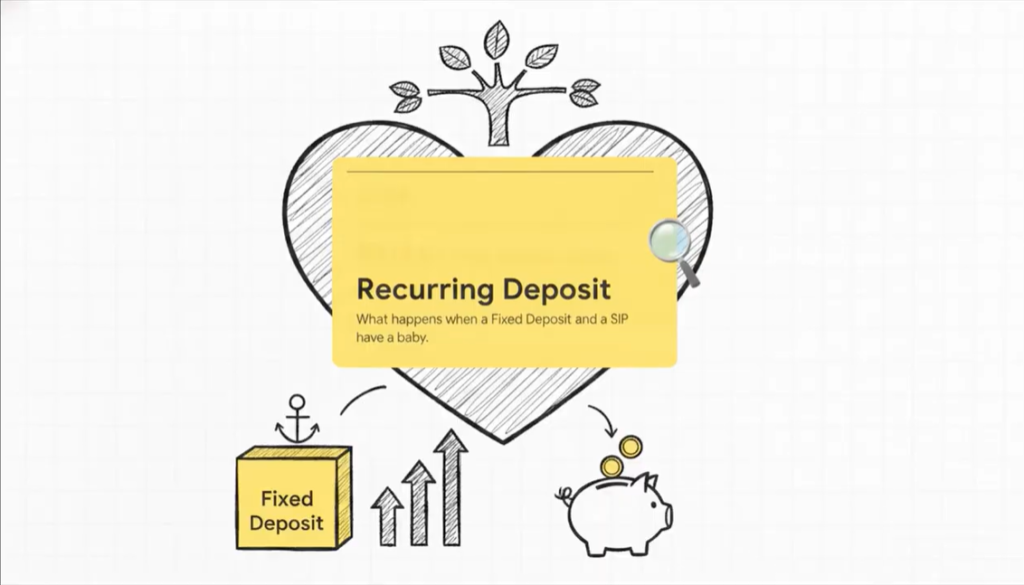
Recurring Deposits A Recurring Deposit (RD) builds a lump sum through fixed monthly instalments over a fixed tenure (6 months to 10 years), at an interest rate aligned with FD rates for the same tenure and compounded quarterly, paid out at maturity. This guide covers missed-instalment penalties, premature closure (typically at a reduced rate, and generally all-or-nothing unlike some FDs), and Flexi RD variants allowing variable instalment amounts. On tax: RD interest is fully taxable at slab rate, with TDS under Section 194A now triggered above ₹50,000 (₹1,00,000 for senior citizens) per bank for FY 2025-26 onwards — Form 15G/15H can avoid the upfront deduction where total income is below the taxable threshold. We draw a clear RD-vs-SIP comparison: an RD is a fixed-rate, DICGC-insured (₹5 lakh per depositor per bank), fully-taxable-at-slab-rate promise, while a SIP into mutual funds is market-linked with potentially more favourable capital gains tax treatment (per tackl.finance’s mutual funds note) — making RDs better suited to short-horizon, certainty-driven goals and SIPs better suited to long-term wealth building.

Bank Accounts

Current Accounts

Current Accounts: The Business Engine A current account is the operational account for businesses and professionals — unlimited transactions, no transaction-count restrictions, but no interest on the balance, and a higher minimum balance requirement than savings accounts. This guide covers eligible entities and the business-proof documentation required to open one (GST registration, partnership deeds, MOA/AOA and board resolutions for companies), and explains Overdraft (OD) and Cash Credit (CC) facilities — both allowing drawdowns beyond the account balance with interest charged only on utilisation, with CC specifically tied to inventory/receivables-based drawing power. We cover a 2020 RBI circular aimed at preventing borrowers from routing transactions through current accounts at banks other than where they hold CC/OD facilities — relevant for any business banking with multiple institutions — and close with sweep-in/auto-sweep facilities that automatically move idle current account surplus into interest-earning fixed deposits (Topic 4), plus practical notes on cash-handling charges and digital/neo-banking current account platforms.

Loan & Credit

Loan Eligibility Calculator

Loan Eligibility Calculator The Loan Eligibility Calculator estimates the maximum loan amount a borrower can be sanctioned, based on their net monthly income, existing EMI obligations, and the proposed loan’s interest rate and tenure. Indian banks typically apply a Fixed Obligation to Income Ratio (FOIR) of 40–55%. This is a pre-qualification tool — it sets realistic expectations before a user applies. Results should be shown as an indicative range, not a guarantee. Gross Monthly Income ₹ ₹10K₹10L Other Monthly Income ₹ ₹0₹5L Existing EMI Obligations ₹ ₹0₹5L Desired Tenure M 12 M360 M Interest Rate % 1%25% FOIR Assumption % 40%70% Eligible Loan ₹0 Maximum EMI ₹0 Total Monthly Income₹0 Maximum Allowable EMI₹0 Existing EMI₹0 Eligible EMI Capacity₹0 Maximum Eligible Loan₹0 Total Interest Payable₹0 Total Repayment₹0

Loan & Credit

Standard EMI Calculators

Standard EMI Calculators The Standard EMI (Equated Monthly Instalment) Calculator computes the fixed monthly payment a borrower must make to fully repay a loan — principal plus interest — over a chosen tenure. It is applicable to home loans, personal loans, car loans, and any amortising loan with a fixed interest rate.This is the most-used financial calculator in India. It must be pixel-perfect in accuracy because users will cross-check against bank sanction letters. Principal Loan Amount ₹ ₹1 L₹10 Cr Annual Interest Rate % 1%25% Loan Tenure Y 1 Y30 Y Monthly EMI : ₹0 Total Amount Payable ₹0 Principal Amount ₹0 Interest Amount ₹0 Monthly EMI₹0 Total Interest Payable₹0 Total Amount Payable₹0 Interest as % of Principal0% Approx. Payoff Duration0 years

ECONOMY

Inflation: The Basics

Inflation: The Basics When prices crawl upward across the country, it doesn’t just mean your weekly expenses are rising; it means the purchasing power of your money is being systematically stripped away. A stable 3.40% Consumer Price Index (CPI) in early 2026 sounds harmless on paper, but your hard-earned cash is silently losing its muscle while sitting idle.  Instead of asking how you can cut back to save cash, you need to ask a more critical question: “How do I make my wealth grow faster than the true cost of living?”  Inflation acts as a hidden tax on your lifestyle, functioning through three specific wealth-destroying mechanisms: Standing still with your cash in April 2026 is the riskiest financial move you can make; inflation is the gravity of the financial world, and you must out-invest it simply to stay at the same height.  Watch this video to calculate your personal CPI and discover how to deploy equities, gold, and strategic debt to permanently neutralize the invisible thief.

Financial Frauds & Safety

Be Sure It’s Your Bank

Be Sure It’s Your Bank 1. Is It Really My Bank Calling? You receive a call at an odd hour and the person speaking at the other claims that they are calling you from your bank.  How can you be sure that it’s your bank that’s calling and not a fraudster? By looking at the 10-digit incoming call number. Banks in India are mandated to use specific number series when calling customers/prospects. Calls from these numbers help distinguish genuine bank communications from scams. 2. Is It Really My Bank’s Website? You receive a WhatsApp message from what looks like your bank that is asking you to click on a link and update your personal information.  Firstly, DO NOT CLICK on any links received on any of the social media platforms.  Secondly, how do you ensure that it’s your bank’s genuine Website that you are accessing? Look for the domain ending in “.bank.in” Whether you have an account with a private bank like HDFC or a public sector bank like SBI or a foreign bank like HSBC or a small regional rural bank (RRB) or a cooperative bank, all their Websites in India will now have a unique domain that ends with .bank.in, which isn’t available for anyone else to register.  3. Is it Really My Insurance Company’s Website? Like with banks, RBI has introduced the .fin.in domain for all Non-Banking Finance Companies (NBFCs) including insurance companies.  These changes mandated by RBI  will significantly enhance cybersecurity and trust in India’s financial ecosystem. These changes will help curb digital fraud, protect consumers, and establish a secure online presence for financial institutions. Unlike regular “.com” or “.in” domains, “.bank.in” or “.fin.in” are exclusive to verified Indian banks, ensuring that customers can easily identify authentic websites. 

Financial Frauds & Safety

How to Report Financial Cybercrimes?

How to Report Financial Cybercrimes? When a security perimeter fails and you fall prey to an aggressive financial cybercrime, the velocity of your immediate response dictates your recovery odds. The initial sixty minutes post-incident function as the critical “Golden Hour” for tracking and capturing stolen funds before they exit the banking pipeline. Initiating structured legal reporting and gathering ironclad digital evidence allows central networks to freeze illicit balances effectively.  Before you succumb to panic or delay incident notification during a severe financial compromise, you need to ask a much harder question: “Have I mobilized the national helpline to intercept the fraudster’s routing chain?” Navigating the financial cybercrime recovery workflow requires executing three immediate operational phases: Neglecting to quickly update your banking fraud desk and track your case ID leaves your lost capital permanently unrecoverable.  Watch this video to navigate the complete step-by-step financial cybercrime reporting workflow and discover how to legally recover your stolen assets.

Book an Appointment Form